
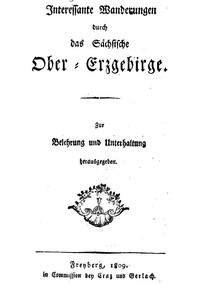
Interessante Wanderungen durch das Sächsische Ober-Erzgebirge by Wild
Let's be clear from the start: this isn't a novel. Interessante Wanderungen durch das Sächsische Ober-Erzgebirge (Interesting Walks through the Saxon Upper Ore Mountains) is exactly what it says on the tin—a guidebook. But calling it just a guidebook is like calling an old family recipe 'just instructions.' Published in the early 1800s, it's a deeply personal tour of a specific, rugged part of Germany, written by a local pastor, Christian Gottlob Wild.
The Story
There's no traditional plot. Instead, Wild structures his book as a series of walks or tours. He picks a starting point, like a town or a crossroads, and then describes exactly what you would see walking from there. He notes the turns in the path, the quality of the road, the farms you pass, and the mountains that come into view. He tells you where to find a good spring for water and which hilltop offers the most breathtaking panorama. Woven into these practical directions are snippets of history, folklore about particular rocks or woods, and observations about the mining communities that defined the region. The 'story' is the journey itself and the slow, detailed revelation of a landscape through the eyes of someone who loved it.
Why You Should Read It
This book is a quiet miracle of observation. Wild's writing has no flashy style, but its precision is its power. You get the sense he walked these routes countless times, noticing everything. Reading it, you aren't just learning about a place; you're learning how to see a place. You start to notice how geography shapes communities, how paths follow logic invisible on a flat map. It’s also surprisingly moving. This is a snapshot of a world on the cusp of massive change. The railways and factories that would transform Europe were just arriving. Wild's record is a loving portrait of a rural, close-knit world, preserved in ink just before it began to fade.
Final Verdict
This is a niche read, but a profoundly rewarding one. It's perfect for history buffs, armchair travelers, and anyone fascinated by local history or historical geography. If you enjoy old maps, travel diaries, or the idea of 'deep time' in a landscape, you'll find it captivating. It's not a page-turner in the usual sense, but a book to savor slowly, perhaps with a modern map open beside it. Think of it as a long, thoughtful letter from the past, inviting you for a walk. You just have to be willing to take the first step.
This content is free to share and distribute. You do not need permission to reproduce this work.







Emily Torres
9 months agoHaving read this twice, the depth of research presented here is truly commendable. I will read more from this author.