
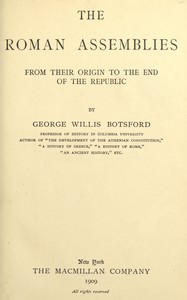
The Roman assemblies from their origin to the end of the Republic by Botsford
Forget everything you think you know about rigid, top-down Roman rule. George Willis Botsford's The Roman Assemblies is a deep dive into the opposite: the vibrant, chaotic, and foundational world of Roman popular politics. This isn't a narrative about emperors, but a forensic examination of the machinery that allowed citizens to participate in their own government for over 400 years.
The Story
Botsford doesn't tell a story with characters, but with institutions. He starts at the very beginning, with the shadowy origins of Rome's public assemblies. He walks us through the different types—the Curiate, Centuriate, and Tribal assemblies—explaining not just what they were, but how they actually functioned. Who could vote? Where did they meet? How did a law go from a proposal to reality? The book follows the twisting path of these assemblies as Rome grew from a city to a world power. We see how they gained strength, how they clashed with the Senate, and how, ultimately, the system became too strained and corrupt to survive the ambitions of men like Sulla, Pompey, and Caesar. The 'plot' is the life and death of an idea: that Roman citizens, through organized collective action, held legitimate power.
Why You Should Read It
This book completely reframes Roman history. It makes you realize the Republic wasn't just a Senate full of old men in togas; it was a living, breathing political organism with a loud and sometimes messy popular component. Botsford's detail can be dense, but the payoff is huge. You start to see the Forum not as a tourist site, but as a stage for political drama where the fate of laws and wars was decided by crowd votes. It adds a layer of grit and reality to a period often polished by legend. You understand the stakes of the Republic's fall so much better when you see what was lost—not just 'liberty' in the abstract, but a specific, centuries-old system for channeling the public will.
Final Verdict
This is a book for the curious history lover who wants to look under the hood of the Roman Republic. It's perfect for readers who enjoyed books like Tom Holland's Rubicon but now want to understand the mechanics of the politics he describes. It's not a breezy read—it's a serious, academic work from the early 1900s—but its insights are timeless. If you've ever asked, 'But how did their government actually WORK?' this is your essential, if sometimes challenging, answer.
Legal analysis indicates this work is in the public domain. It is now common property for all to enjoy.








Lisa Rodriguez
11 months agoBased on the summary, I decided to read it and the flow of the text seems very fluid. One of the best books I've read this year.