
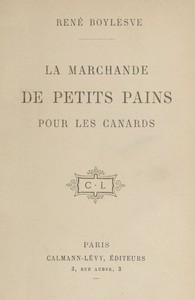
La marchande de petits pains pour les canards by René Boylesve
René Boylesve’s La Marchande de Petits Pains pour les Canards is a quiet, almost painfully observant little novel. Published in 1899, it captures a slice of Parisian life that most people would simply walk past.
The Story
The story follows Madame Goussot, an older, unmarried woman who lives a life of stifling routine. Her sole occupation and joy is her daily trip to the Luxembourg Gardens. There, she buys stale bread rolls—petits pains—specifically to feed the ducks in the pond. This ritual is her entire universe: her connection to the outside world, her sense of usefulness, and her only social interaction (if you can call scattering crumbs for ducks ‘social’). The plot revolves around the delicate balance of her existence. We see her small economies, her quiet observations of other regulars in the garden, and the profound importance this one act holds for her. The tension comes from the fragility of this world. What if the ducks were gone? What if the bread-seller raised his prices? For Madame Goussot, these aren't minor inconveniences; they are existential threats to the only thing that gives her life meaning.
Why You Should Read It
This book won’t give you adventure or romance. What it gives you is a deep, compassionate look at a life lived on the margins. Boylesve doesn’t judge Madame Goussot or ask for our pity. Instead, he simply shows us her world with startling clarity. The beauty is in the details: the weight of the bread bag, the specific ducks she recognizes, the way she measures her week by this daily pilgrimage. It makes you think about all the people we overlook every day, and the private worlds of meaning they build for themselves. It’s a masterclass in writing a character who says little but feels everything.
Final Verdict
This is a book for patient readers and lovers of character studies. If you enjoy the subtle, psychological depth of writers like Katherine Mansfield or the early stories of Alice Munro, you’ll find a kindred spirit in Boylesve. It’s also perfect for anyone interested in late 19th-century French literature that steps away from grand dramas to focus on ordinary, ‘unimportant’ lives. Be warned: it’s melancholic and slow-paced, but in the best possible way. It’s the literary equivalent of watching light change in a room—nothing seems to happen, but everything feels different when you’re done.
There are no legal restrictions on this material. You are welcome to share this with anyone.
Patricia Johnson
9 months agoBefore I started my latest project, I read this and the concise summaries at the end of each section are a lifesaver. The price-to-value ratio here is simply unbeatable.
Kimberly Smith
1 year agoInitially, I was looking for a specific answer, but the transition between theoretical knowledge and practical application is seamless. It’s hard to find this much value in a single source these days.
Charles Garcia
2 months agoThe clarity of the introduction set high expectations, and the way the author breaks down the core concepts is remarkably clear. I appreciate the effort that went into this curation.
Donald Taylor
9 months agoIt took me a while to process the complex ideas here, but the cross-referencing of different chapters makes it a great study tool. Definitely a five-star contribution to the field.







Sarah Garcia
3 months agoAfter spending a few days with this digital edition, the cross-referencing of different chapters makes it a great study tool. Finally, a source that prioritizes accuracy over hype.