
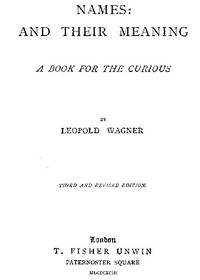
Names: and Their Meaning; A Book for the Curious by Leopold Wagner
Leopold Wagner's Names: and Their Meaning isn't a novel with a plot, but it has a clear mission. Think of it as a friendly guidebook to the history hidden in plain sight. Wagner, writing in the late 19th century, gathers first names, surnames, and place names from various cultures, primarily focusing on European traditions. He breaks them down, tracing their roots back to ancient languages like Hebrew, Greek, Latin, and Old German. The 'story' is the journey of the words themselves—how 'Richard' comes from words meaning 'powerful and brave,' how the surname 'Cooper' simply meant 'barrel-maker,' and how town names often describe their location ('ton' for town, 'ford' for a river crossing). He organizes this exploration into clear categories, making it easy to dip in and out.
Why You Should Read It
This book is a joy because of Wagner's obvious enthusiasm. You can feel his delight in making connections. It turns a simple introduction—"Hi, my name is..."—into a moment full of potential history. Reading it, you start playing detective in your own life. You'll find yourself pausing at street signs, wondering about their origins, or looking at a friend's last name with new curiosity. It’s not a dry academic text; it's accessible and written for anyone who's ever asked, "What does that mean?" While some of the historical or linguistic ideas might be dated by modern standards, that's part of its charm. It's a snapshot of how people over a century ago understood identity and language.
Final Verdict
This book is perfect for curious minds, trivia lovers, writers looking for authentic period name ideas, or anyone who enjoys etymology (the history of words). It's a fantastic bathroom book or coffee table read—great for short, satisfying bursts of discovery. If you want a rigorous, modern linguistic text, look elsewhere. But if you'd enjoy a charming, conversational trip through the stories behind what we call each other, guided by a passionate Victorian-era enthusiast, then Leopold Wagner's curious little volume is a genuine delight.
This publication is available for unrestricted use. Thank you for supporting open literature.
Paul Clark
1 year agoThis book was worth my time since the character development leaves a lasting impact. Thanks for sharing this review.
Dorothy Lopez
1 year agoI stumbled upon this title and the author's voice is distinct and makes complex topics easy to digest. A true masterpiece.
Daniel Lee
1 year agoHonestly, the arguments are well-supported by credible references. Exactly what I needed.
Thomas Allen
1 year agoI have to admit, the flow of the text seems very fluid. Absolutely essential reading.

Mark King
1 year agoI didn't expect much, but it creates a vivid world that you simply do not want to leave. A true masterpiece.