
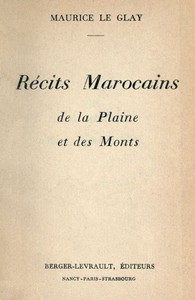
Récits marocains de la plaine et des monts by Maurice Le Glay
If you're imagining a single, continuous plot, this book isn't that. 'Récits marocains de la plaine et des monts' is better described as a collection of vivid scenes and character portraits. Maurice Le Glay, writing from his experiences in early 20th-century Morocco, acts as our guide. He takes us from the bustling plains, where the influence of colonial administration is most felt, to the remote, rugged mountains where ancient Berber customs hold strong.
The Story
There isn't one story, but many. We meet local leaders navigating their loyalty between their people and the new French authorities. We see the stark realities of justice, poverty, and honor in small communities. Some tales feel like folktales, while others read like tense, real-life dramas. The 'conflict' here isn't a simple good-versus-evil battle. It's the quieter, more complex friction of cultures meeting, of a society figuring out its identity under pressure. Le Glay doesn't paint himself as a hero; often, he's just an observer, sometimes confused, sometimes admiring, trying to make sense of the world around him.
Why You Should Read It
This book surprised me. I picked it up expecting a historical document and found real people. Le Glay has a keen eye for detail—the way a bargain is struck in a market, the silence of a mountain trail, the weight of a shared meal. You feel the heat of the sun and the chill of distrust. Yes, it's a product of its time and his position, which adds a fascinating (and critical) layer. You're not just seeing Morocco through his eyes; you're also seeing how a colonial officer saw it. That dual perspective—the lives he describes and the lens he uses—is what makes it so compelling and thought-provoking today.
Final Verdict
This is a perfect pick for readers who love immersive travel writing or historical accounts that focus on human stories over dates and treaties. If you enjoyed books like The Sheltering Sky for its atmosphere or are curious about North African history from a ground-level view, you'll find a lot here. It's not a light beach read, but for a quiet afternoon when you want to be transported to another time and place, it's absolutely captivating. Just be ready to think about what you're reading, not just breeze through it.
This masterpiece is free from copyright limitations. Knowledge should be free and accessible.
Emily Hernandez
8 months agoExceptional clarity on a very complex subject.
Susan Johnson
1 year agoWow.
Sandra Allen
1 year agoHigh quality edition, very readable.
Margaret Jones
10 months agoAfter hearing about this author multiple times, the plot twists are genuinely surprising. Don't hesitate to start reading.
Joseph Perez
1 year agoThis is now a staple reference in my professional collection.