About 181 minutes
The Phantom Airman — A Closer Reading
Fairy Moral Tales
41,550 recorded words. 12 minutes difference from this book's estimate.
View Gutenberg source #43264
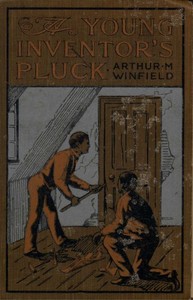
For A Young Inventor's Pluck; or, The Mystery of the Willington Legacy — Inside the Classic, the stored edition analysis reports 44,183 words, 3 hr 13 min estimated reading time, and 9 detected text sections.
The text analysis averages about 12.1 words per sentence, while the detected sections provide another way to judge how the source is divided.
Project Gutenberg metadata also associates the work with “Orphans -- Juvenile fiction,” connecting these edition facts with the source record’s subject description.
Explore this collection
These alternatives are selected using recorded categories and estimated reading time.
About 181 minutes
Fairy Moral Tales
41,550 recorded words. 12 minutes difference from this book's estimate.
View Gutenberg source #43264About 211 minutes
Fairy Moral Tales
48,323 recorded words. 18 minutes difference from this book's estimate.
View Gutenberg source #43197About 212 minutes
Fairy Moral Tales
48,555 recorded words. 19 minutes difference from this book's estimate.
View Gutenberg source #43269Search stored excerpts and compare books → Choose by your preferences →
Choices use stored catalog measurements. Estimates vary with reading speed. A shared category is a catalog label, not a claim that two books have the same argument or literary quality.
Search reads excerpt text stored with this catalog and links to its associated Gutenberg record. The connection is stored in the site database; this tool does not recheck that every excerpt is word-for-word identical to that external record. Excerpt search does not cover every chapter and does not verify historical publication dates.
Catalog snapshot checked: 2026-09-26. Coverage: 90 public books, 90 available source excerpts.
Calculated from edition completeness, EPUB availability, text structure and catalogue metadata. Not a user rating.
Total of 100 points, scaled to a 2.5-5.0 range. Editions with an empty description or a missing EPUB file are not scored.
Public-domain source text
The source text is kept in the dedicated reader, separate from this catalogue record and its commentary.
The story opens with Jack Willington, a young machinist, learning that the tool works where he is employed has shut down. The bank holding his and his sister Deb's savings has also failed. Jack is immediately accused of setting a large fire in town, adding to his troubles. The author, writing as Arthur M. Winfield, sets a brisk pace by layering these disasters in the first chapter. Jack's mechanical skill and his nearly completed model of an invention are introduced as his primary assets. The narrative voice is direct, focusing on action and dialogue rather than introspection. Readers should note how quickly the plot moves from financial ruin to legal peril, establishing a pattern of escalating obstacles.
The excerpts depict a factory town where work is unstable and gossip spreads fast. Jack's employment at the tool works is central to his identity, and its closure forces him to rely on his inventiveness. The author emphasizes the town's rhythms: the mill, the river, and the close quarters of homes. When Jack is accused of incendiarism, the community's suspicion is immediate. The setting is not merely background; it shapes the characters' choices. Jack's sister Deb, for instance, is shown managing the household while he works. The pressure of supporting her is a constant undercurrent. The narrative does not romanticize factory life but presents it as a grind, with moments of excitement arising from crises rather than leisure.
Max Pooler, the miser of the island, is introduced through a tense meal scene. He charges Jack and his companion Mont a quarter each for a simple meal, then another quarter for a boat ride. His dialogue reveals a superstitious streak: he claims to have seen a ghost in the falls, the spirit of a man who went over one night. Jack dismisses the ghost, but Pooler insists, saying the spirit sometimes comes to the island. The girl Meg, Pooler's daughter or ward, is more sympathetic, biting her nails in vexation at her father's meanness. The island itself becomes a place of hidden treasure and secrets, as hinted by the chapter title "The Miser's Treasure." Pooler's character is drawn with broad strokes—grasping, fearful, and isolated—making him a memorable obstacle.
Much of the story's momentum comes from dialogue. Conversations reveal character and advance the mystery. In the excerpt, Mont and Jack's exchange with Max Pooler about the ghost is a good example: Pooler's earnestness contrasts with Jack's skepticism, while Mont's joking deflection keeps the mood light. The dialogue also conveys information economically. When Pooler asks, "But did you see 'em?" in a tragic whisper, the reader learns that local lore is important. Later, Meg's outburst—"The mean miser"—confirms the reader's impression. The author uses speech tags like "broke in" and "replied" to keep exchanges snappy. Readers should pay attention to what characters say and what they omit; Mont's careful avoidance of names during his story hints at secrets.
Jack's identity as an inventor is established early: he has a model of a "useful and valuable invention" nearly ready. This model is his ticket to solving his problems, but the excerpts do not reveal its nature. The title's "mystery of the Willington legacy" suggests a family inheritance, and the chapter list includes "Papers of Great Value" and "A Glimpse of the Past." The legacy is likely connected to the miser's treasure or to Jack's own family history. The invention and the legacy are parallel threads: one represents Jack's skill and future, the other his past. How these threads intertwine is a central question. Readers should watch for clues about the invention's purpose and the legacy's origin, as they are the keys to the plot's resolution.
This story rewards attention to small details: a character's nervous habit, a repeated phrase, or a seemingly offhand remark about a ghost. The author builds suspense through accumulation of setbacks and narrow escapes. As you read, note how Jack's mechanical skill is used not just for invention but for problem-solving in tight spots. The mystery of the Willington legacy unfolds gradually, and the early chapters lay groundwork that pays off later. Keep an eye on the island and its inhabitants—they hold more than meets the eye.
I kept thinking about Jack and Deb, how their stubborn hope felt like a quiet lantern in all that factory smoke. It reminded me of another book, Girls of the True Blue — Background and Themes, where the same gentle grit runs through the girls’ daily lives. That feeling stays with you, soft as an old photograph.
Save your reaction, strongest insight, and memorable passage.