About 367 minutes
The Secret Cache: An Adventure and Mystery Story for Boys — Context and Discussion
Fairy Moral Tales
84,340 recorded words. 42 minutes difference from this book's estimate.
View Gutenberg source #43293
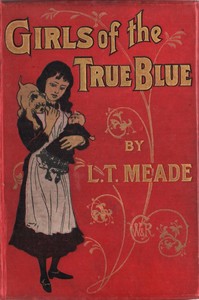
Before opening Girls of the True Blue — Background and Themes, the edition data offers a quick orientation: 94,008 words, 6 hr 49 min estimated reading time, and 9 detected text sections.
The text analysis averages about 13.0 words per sentence, while the detected sections provide another way to judge how the source is divided.
Project Gutenberg metadata also associates the work with “Orphans -- Juvenile fiction,” connecting these edition facts with the source record’s subject description.
Explore this collection
These alternatives are selected using recorded categories and estimated reading time.
About 367 minutes
Fairy Moral Tales
84,340 recorded words. 42 minutes difference from this book's estimate.
View Gutenberg source #43293About 291 minutes
Fairy Moral Tales
66,921 recorded words. 118 minutes difference from this book's estimate.
View Gutenberg source #42953About 230 minutes
Fairy Moral Tales
52,896 recorded words. 179 minutes difference from this book's estimate.
View Gutenberg source #42461Search stored excerpts and compare books → Choose by your preferences →
Choices use stored catalog measurements. Estimates vary with reading speed. A shared category is a catalog label, not a claim that two books have the same argument or literary quality.
Search reads excerpt text stored with this catalog and links to its associated Gutenberg record. The connection is stored in the site database; this tool does not recheck that every excerpt is word-for-word identical to that external record. Excerpt search does not cover every chapter and does not verify historical publication dates.
Catalog snapshot checked: 2026-09-26. Coverage: 90 public books, 90 available source excerpts.
Calculated from edition completeness, EPUB availability, text structure and catalogue metadata. Not a user rating.
Total of 100 points, scaled to a 2.5-5.0 range. Editions with an empty description or a missing EPUB file are not scored.
Public-domain source text
The source text is kept in the dedicated reader, separate from this catalogue record and its commentary.
The opening scene of Girls of the True Blue introduces a household governed by military discipline: Captain Richmond keeps an 'orderly-book' where conduct marks are recorded, and the girls are referred to as 'soldiers' in his battalion. The narrative voice quickly establishes a contrast between surface obedience and internal resistance. Augusta, anxious about a bad mark for cruelty, lies awake 'tossing from side to side,' while Nan, the orphaned cousin, openly defies Mrs. Richmond's suggestion to discard her battered doll, declaring she 'would not give up dear Sophia Maria for anybody on earth.' This early friction between authority and personal loyalty sets the pattern for the story's central conflicts.
The orderly-book functions as both a literal object and a symbol of external judgment. Augusta's dread of Captain Richmond's scrutiny—'he would come on Augusta at that moment of her career as a sort of Nemesis'—reveals how the system of rewards and punishments shapes the girls' behavior. Yet the excerpts show that the marks do not capture the full moral complexity of their actions. Augusta's cruelty to Nancy, for instance, is mentioned but not detailed; the reader sees only her fear of exposure, not the incident itself. This gap between the official record and private motive is a recurring pattern. The girls also manipulate the system: when Mrs. Richmond departs, Augusta immediately proposes to 'take all the fun we can out of' the Asprays, a new set of acquaintances her mother would likely disapprove of. The orderly-book thus becomes a tool for self-justification as much as discipline.
Several objects in the excerpts carry emotional weight beyond their practical use. Nan's doll Sophia Maria is described as 'battered' and 'horrid old' by Mrs. Richmond, but Nan clings to it as a non-negotiable possession. The doll represents continuity and defiance in a world where the girl has little control. Similarly, the 'frock with crape' (chapter title III) and the 'packet of letters' (chapter XXV) hint at material items that may hold secrets or memories. The illustrations listed—such as 'Nan was perfectly satisfied to sit near the fire holding the kittens' and 'Augusta in terror was hiding behind a bush of laurustinus'—suggest that key emotional beats are staged around tangible things: animals, hiding places, written notes. These objects ground the characters' inner lives in physical detail.
The Asprays—Flora and Constance—are introduced as a disruptive force even before they appear. Mrs. Richmond leaves without explaining who they are, and the girls are left to speculate. Augusta anticipates 'a splendid time' with these 'brilliant, handsome, gay sort of girls,' while Kitty and Nora suspect they are 'not a bit the sort of girls that mother would like.' The arrival of outsiders tests the household's internal codes. Augusta's eagerness to enjoy their company despite knowing 'they won't suit' Uncle Peter reveals her willingness to prioritize personal pleasure over family harmony. The chapter titles 'The Mystery-Girl' and 'The Bull-Pup' further suggest that new characters bring unpredictable complications. The excerpts do not reveal the Asprays' actual behavior, but the tension around their visit underscores how the closed world of Fairleigh is vulnerable to outside influence.
Readers attentive to the interplay between official rules and private feelings will find the orderly-book a useful lens for tracking each girl's moral trajectory. The excerpts offer only fragments of the full story, but they establish a world where a doll, a mark, or a new acquaintance can become a flashpoint. Pay particular attention to how characters use or resist the language of duty—and to the moments when silence or a sideways glance speaks louder than any entry in the book.
Reading about Nan’s fierce grip on Sophia Maria, I felt that ache of childhood loyalty. It reminds me of the easy faith in comradeship found in The Motor Boys; or, Chums Through Thick and Thin — A Closer Reading. Those old stories never let go of that quiet vow: we hold on, even when the world demands we let go.
Answer a few questions and save a private reflection on this device.