About 209 minutes
The Sky Trail — Background and Themes
Childrens Adventures
47,958 recorded words. 2 minutes difference from this book's estimate.
View Gutenberg source #45485
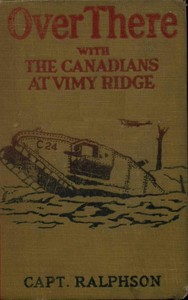
The catalog record for Over There with the Canadians at Vimy Ridge — Reading Notes provides practical reading context through 47,464 words, 3 hr 27 min estimated reading time, and 8 detected text sections.
The text analysis averages about 18.5 words per sentence, while the detected sections provide another way to judge how the source is divided.
Project Gutenberg metadata also associates the work with “Spy stories,” connecting these edition facts with the source record’s subject description.
Explore this collection
These alternatives are selected using recorded categories and estimated reading time.
About 209 minutes
Childrens Adventures
47,958 recorded words. 2 minutes difference from this book's estimate.
View Gutenberg source #45485About 210 minutes
Childrens Adventures
48,229 recorded words. 3 minutes difference from this book's estimate.
View Gutenberg source #44013About 203 minutes
Childrens Adventures
46,590 recorded words. 4 minutes difference from this book's estimate.
View Gutenberg source #44059Search stored excerpts and compare books → Choose by your preferences →
Choices use stored catalog measurements. Estimates vary with reading speed. A shared category is a catalog label, not a claim that two books have the same argument or literary quality.
Search reads excerpt text stored with this catalog and links to its associated Gutenberg record. The connection is stored in the site database; this tool does not recheck that every excerpt is word-for-word identical to that external record. Excerpt search does not cover every chapter and does not verify historical publication dates.
Catalog snapshot checked: 2026-09-26. Coverage: 90 public books, 90 available source excerpts.
Calculated from edition completeness, EPUB availability, text structure and catalogue metadata. Not a user rating.
Total of 100 points, scaled to a 2.5-5.0 range. Editions with an empty description or a missing EPUB file are not scored.
Public-domain source text
The source text is kept in the dedicated reader, separate from this catalogue record and its commentary.
The opening pages of Over There with the Canadians at Vimy Ridge immediately establish a setting far from the catalog’s straightforward war-and-spy categories. Two soldiers crouch in a camouflaged pit in No Man’s Land, whispering under a mist-laden dusk. The text dwells on the mud, the fog, and the whistle of an approaching shell—details that ground the scene in sensory specifics. Yet the response to that shell is not tactical but personal: Lieutenant Tourtelle strikes Private Irving Ellis with the back of his hand for speaking a warning. This moment of casual violence, delivered without regard for noise discipline, hints at tensions that may shape the narrative more than the battle itself.
The excerpt from Chapter I presents a listening post as a place of enforced silence—yet the lieutenant’s blow is described as “vicious” and delivered with “apparently no effort to subdue the tone of his voice.” The contradiction between the rules of the post and the officer’s behavior is striking. The catalog lists “Spy stories” as a subject, but here the focus is on interpersonal friction rather than espionage. The whispering, the fog, and the camouflaged pit create a tense atmosphere, but the narrative quickly shifts to the internal dynamics of the pair. Readers expecting a conventional war story may find the emphasis on character conflict more prominent than tactical action.
Later excerpts describe Irving testing a “sky-umbrella” parachute, with careful attention to the risk of ripping silk and the need for dummy tests. The language is methodical: “Before each of his experiments, Irving had tested the ‘sky-umbrella’ with a dummy heavier than himself.” This technical detail contrasts with the catalog’s spy-story label, suggesting an interest in mechanical innovation. The parachute is used during an aeroplane flight over the front, where Irving observes the blowing up of Vimy Ridge from above. The scene mixes precise observation—trenches like “pen scratches on a dim-colored sheet”—with a philosophical aside about humanity’s greed. The catalog does not prepare readers for this blend of engineering and reflection.
The description of Vimy Ridge’s destruction from the air is the most visually elaborate passage in the excerpts. Irving sees “an upheaval of earth” followed by a “regular concert of upheavals” that transform the ridge into a “long, a very long, crater.” Soldiers below appear as “mice” or “insects” dashing forward. The catalog subject “Vimy Ridge, Battle of, France, 1917” suggests a ground-level account, but the narrative here is airborne, emphasizing scale and detachment. Irving’s musing—“if the world could only get up here and look at itself”—introduces a reflective tone uncommon in juvenile adventure fiction. The catalog’s categories do not capture this shift in perspective or the speculative, almost philosophical, turn the text takes.
Readers approaching this work through its catalog subjects should note that the excerpts emphasize character friction, experimental technology, and an aerial vantage point more than conventional spycraft or battlefield heroics. The narrative voice alternates between precise technical description and detached observation, with occasional moments of wry commentary. The book may reward those interested in early twentieth-century adventure fiction that incorporates mechanical detail and a somewhat unconventional point of view.
Years at the desk have taught me that far-flung shelves whisper to each other. The Vimy Ridge notes, all wire and waiting, share a certain stillness with The Brownie Scouts at Silver Beach — Story, Setting & Ideas—the hush before a signal, the held breath before a wave turns. One hears it in trenches, the other in tide pools, yet both listen for what comes next.
Create a short personal record of your experience with this book.