About 282 minutes
A Dog of Flanders, The Nürnberg Stove, and Other Stories — Key Ideas to Explore
Childrens Adventures
64,645 recorded words. 2 minutes difference from this book's estimate.
View Gutenberg source #50032
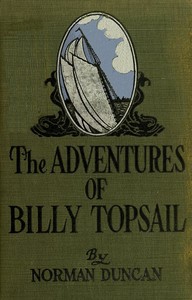
This digital edition of The Adventures of Billy Topsail — Reading Notes is described by source-level measurements including 65,153 words, 4 hr 44 min estimated reading time, and 9 detected text sections.
The text analysis averages about 14.6 words per sentence, while the detected sections provide another way to judge how the source is divided.
Project Gutenberg metadata also associates the work with “Sea stories,” connecting these edition facts with the source record’s subject description.
Explore this collection
These alternatives are selected using recorded categories and estimated reading time.
About 282 minutes
Childrens Adventures
64,645 recorded words. 2 minutes difference from this book's estimate.
View Gutenberg source #50032About 292 minutes
Childrens Adventures
67,003 recorded words. 8 minutes difference from this book's estimate.
View Gutenberg source #45582About 271 minutes
Childrens Adventures
62,257 recorded words. 13 minutes difference from this book's estimate.
View Gutenberg source #47358Search stored excerpts and compare books → Choose by your preferences →
Choices use stored catalog measurements. Estimates vary with reading speed. A shared category is a catalog label, not a claim that two books have the same argument or literary quality.
Search reads excerpt text stored with this catalog and links to its associated Gutenberg record. The connection is stored in the site database; this tool does not recheck that every excerpt is word-for-word identical to that external record. Excerpt search does not cover every chapter and does not verify historical publication dates.
Catalog snapshot checked: 2026-09-26. Coverage: 90 public books, 90 available source excerpts.
Calculated from edition completeness, EPUB availability, text structure and catalogue metadata. Not a user rating.
Total of 100 points, scaled to a 2.5-5.0 range. Editions with an empty description or a missing EPUB file are not scored.
Public-domain source text
The source text is kept in the dedicated reader, separate from this catalogue record and its commentary.
Norman Duncan begins The Adventures of Billy Topsail by directly addressing “the Boy who Reads the Book,” explaining that the island of Newfoundland is “so situated that the inhabitants may not escape adventures.” This framing sets an expectation of episodic, real-life perils rather than fantastical plot. The opening pages describe the colony’s geography—bleak, remote, with no roads—and its people, “hospitable, fearless, tender, simple.” Duncan’s voice is plain and declarative, grounding the reader in a specific, unforgiving landscape before any action begins.
The early chapters introduce Billy Topsail not through dialogue or interior thought but through his reactions to events: he “gasped his disappointment” when a whaling captain withholds a harpoon stroke. The narrative voice stays close to Billy’s perspective, yet the prose remains observational, letting the sea and its creatures dominate the scene.
The author’s prefatory letter to the reader is not a mere courtesy; it establishes a contract. Duncan insists that the adventures are drawn from real boys, and that “if all the adventures of these real boys were written the record would fill many books.” This claim lends the ensuing episodes a documentary weight. The reader is positioned as a confidant, not a passive observer. When the narrative later describes a whale’s death throes—the “blood-red sunset,” the “hon-g-king” sounds—the detail feels reported rather than invented. The opening address primes the reader to attend to authenticity, to notice the specific, unglamorous texture of life on the Newfoundland coast.
The excerpt from Chapter XX reveals a deliberate narrative rhythm. The captain waits fifteen hours for the right shot; the prose mirrors that patience, lingering over the approach: “Steam was shut off. The captain’s eye was at the butt of the gun, and his hand was on the trigger.” The action unfolds in short, measured sentences, each step distinct. When the harpoon finally strikes, the captain’s exclamation—“Ha! It is over!”—is followed by a cheer and the crew running to the winch. But the whale does not die quickly. Duncan devotes a paragraph to its slow death: “He dived and rose and coughed; and at last he sank slowly down, down, and still down.” The pacing forces the reader to sit with the creature’s suffering, a choice that complicates any simple adventure tone.
Throughout the whaling scene, Duncan uses onomatopoeia and repetition to create an auditory landscape. The whales “hon-g-k” and “swish”; the harpoon line pays out with a controlled hum. After the shot, the crew’s cheer breaks the tension, but then the text returns to the whale’s “blowing and hon-g-king and beating the sea with his tail.” The sounds are not decorative—they mark the creature’s presence and its agony. Billy’s muttered “Too bad!” at the end is the only human comment on the mate whale’s escape, and it is understated. The narrative trusts the reader to hear the difference between the captain’s triumphant “Ha!” and Billy’s quiet regret.
The excerpts offer only fragments of Billy’s full story, but they hint at a structure built on partial views. The mate whale rises, “hon-g-ked, dived and was seen no more.” The captain’s earlier patience is rewarded, yet the final image is of something vanishing. Duncan does not resolve every thread; the sea remains a place of disappearances. The reader, like Billy, is left watching the horizon. This openness is not a flaw but a feature of the episodic form. Each adventure is self-contained, yet the gaps between them—the unwritten “many books” of real boys—invite the reader to imagine the untold perils that lie beyond the page.
Because the excerpts are drawn from the opening and a later whaling chapter, the reader encounters the book’s range of tone—from the author’s direct, almost instructional preface to the stark, sensory detail of the hunt. Pay attention to how Duncan handles time: he can compress a fifteen-hour chase into a few paragraphs or expand a moment of dying into a slow, painful passage. The book rewards a reader who notices these shifts in pace and who listens for the sounds of the sea as much as the words of the characters.
There’s something about the patience in Billy Topsail’s quiet watching of the sea that lingers with me, the way small details hold the whole story. It reminded me, oddly, of the Columbia’s riverbanks and that odd photograph confession in The River Motor Boat Boys on the Columbia; Or, The Confession of a Photograph — Text and Context—both worlds feel sturdily real, unhurried, and full of understated tension.
Build a private reading journal entry for this title.