About 191 minutes
Brazilian Gold Mine Mystery — Text and Context
Childrens Adventures
43,728 recorded words. 1 minutes difference from this book's estimate.
View Gutenberg source #51538
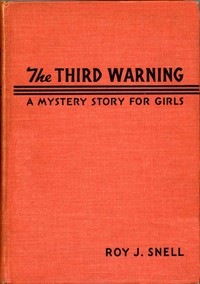
Before opening Third Warning A Mystery Story for Girls — Themes and Context, the edition data offers a quick orientation: 44,111 words, 3 hr 12 min estimated reading time, and 7 detected text sections.
The text analysis averages about 10.8 words per sentence, while the detected sections provide another way to judge how the source is divided.
Project Gutenberg metadata also associates the work with “Mystery and detective stories,” connecting these edition facts with the source record’s subject description.
Explore this collection
These alternatives are selected using recorded categories and estimated reading time.
About 191 minutes
Childrens Adventures
43,728 recorded words. 1 minutes difference from this book's estimate.
View Gutenberg source #51538About 195 minutes
Childrens Adventures
44,828 recorded words. 3 minutes difference from this book's estimate.
View Gutenberg source #45260About 186 minutes
Childrens Adventures
42,714 recorded words. 6 minutes difference from this book's estimate.
View Gutenberg source #44061Search stored excerpts and compare books → Choose by your preferences →
Choices use stored catalog measurements. Estimates vary with reading speed. A shared category is a catalog label, not a claim that two books have the same argument or literary quality.
Search reads excerpt text stored with this catalog and links to its associated Gutenberg record. The connection is stored in the site database; this tool does not recheck that every excerpt is word-for-word identical to that external record. Excerpt search does not cover every chapter and does not verify historical publication dates.
Catalog snapshot checked: 2026-09-26. Coverage: 90 public books, 90 available source excerpts.
Calculated from edition completeness, EPUB availability, text structure and catalogue metadata. Not a user rating.
Total of 100 points, scaled to a 2.5-5.0 range. Editions with an empty description or a missing EPUB file are not scored.
Public-domain source text
The source text is kept in the dedicated reader, separate from this catalogue record and its commentary.
From its first chapter, Third Warning anchors readers in a specific geography: the rocky shores of Isle Royale and the dark waters of Lake Superior. Florence Huyler, introduced as “large, strong, fearless,” is troubled not by the strange yellow clouds on the horizon but by a financial worry—her grandfather’s money. The narrative voice shifts between brisk action and reflective interiority, as when Florence recalls a previous summer spent on a wrecked ship. The excerpts reveal a pattern of contrasts: the tame moose that “are as tame as cattle” versus the sudden violence of a moose charging a dog; the peaceful sunrise over Superior versus the “crimson spot” that hints at fire. These tensions, rooted in the landscape and the characters’ enterprises, drive the story forward without needing the full plot.
The setting is not merely backdrop but an active force. Lake Superior is called “Father Superior at His Worst” in one chapter title, and the characters constantly negotiate its moods. The opening chapter describes clouds “scurrying along the horizon” with a “peculiar shade of yellow,” which the Indian John identifies simply as “Smoke!” This moment of misreading—Florence sees clouds, John sees fire—establishes a pattern where perception and reality diverge. Later, the moose scene on Isle Royale juxtaposes domesticity (a clothesline, a swinging gate) with wildness (the bellowing moose). The animals themselves embody contrast: Plumdum the dog is “courageous” yet small; the moose is “tame enough” until provoked. These details suggest a world where safety is fragile and the boundary between civilization and wilderness is constantly tested.
The narrative voice carries a distinctive blend of adventure and introspection. Florence’s thoughts are “bitter-sweet” as she recalls the wrecked ship from The Phantom Violin, a previous adventure that ended in destruction. This backward glance gives the present journey a shadow of past danger. The prose often shifts from dialogue to internal reflection without transition, as when Florence thinks, “Grandfather will lose his money. He can’t afford to lose, and it’s not all our fault.” The structure of the excerpts—chapter titles like “Flaming Island,” “The Battle of Siskowit,” and “The Crimson Spot”—promises action, but the actual scenes linger on waiting, watching, and worrying. The repeated word “Almost!” in the moose scene, spoken by an unidentified voice, hints at a pattern of near-misses and deferred outcomes that may define the larger plot.
Several details recur across the excerpts, suggesting motifs. Plumdum the dog appears in two scenes: first as a sleeping bundle that escapes, then as a target of the moose. His name, “Plumdum,” is unusual and may signal a comic or loyal role. Fire is another thread: the opening “smoke” clouds, the “crimson spot” of a later chapter, and the chapter “Ashes in Their Hair” all point to a burning threat. Meanwhile, Florence dreams of a radio broadcast: “a chain broadcast, coast to coast! What would that be like?” This ambition contrasts with the immediate danger of the moose and the financial stakes. The gray-haired friend, Colonel Colby, appears with “good news” but is “tantalizingly slow” to deliver it, a narrative technique that builds suspense through withheld information.
Readers approaching Third Warning should pay attention to the gaps between what characters see and what they understand. The excerpts offer a world of misread signs—clouds that are smoke, tame animals that attack, good news that is delayed. The story’s tension lies not only in external dangers but in the characters’ incomplete knowledge. Florence’s worry about her grandfather’s money, the mysterious “gray-haired friend,” and the repeated word “Almost!” all suggest a narrative where outcomes remain uncertain until the final pages.
There's something about Third Warning that stayed with me—that quiet hum of ordinary life tipping toward trouble, the way a familiar place can suddenly feel strange. It reminded me of an old friend, Molly and Kitty, or Peasant Life in Ireland; with Other Tales — Reading Companion, where home itself holds the mystery, and small moments carry a weight you only feel later.
Use these questions to collect your thoughts before moving on.