About 186 minutes
Crossed Trails in Mexico Mexican Mystery Stories #3 — Background and Themes
Childrens Adventures
42,714 recorded words. 0 minutes difference from this book's estimate.
View Gutenberg source #44061
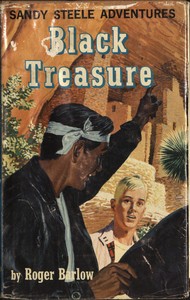
For Black Treasure Sandy Steele Adventures #1 — Themes and Context, the stored edition analysis reports 42,632 words, 3 hr 6 min estimated reading time, and 6 detected text sections.
The text analysis averages about 13.8 words per sentence, while the detected sections provide another way to judge how the source is divided.
Project Gutenberg metadata also associates the work with “Oil fields -- Juvenile fiction,” connecting these edition facts with the source record’s subject description.
Explore this collection
These alternatives are selected using recorded categories and estimated reading time.
About 186 minutes
Childrens Adventures
42,714 recorded words. 0 minutes difference from this book's estimate.
View Gutenberg source #44061About 185 minutes
Childrens Adventures
42,391 recorded words. 1 minutes difference from this book's estimate.
View Gutenberg source #44060About 185 minutes
Childrens Adventures
42,532 recorded words. 1 minutes difference from this book's estimate.
View Gutenberg source #51696Search stored excerpts and compare books → Choose by your preferences →
Choices use stored catalog measurements. Estimates vary with reading speed. A shared category is a catalog label, not a claim that two books have the same argument or literary quality.
Search reads excerpt text stored with this catalog and links to its associated Gutenberg record. The connection is stored in the site database; this tool does not recheck that every excerpt is word-for-word identical to that external record. Excerpt search does not cover every chapter and does not verify historical publication dates.
Catalog snapshot checked: 2026-09-26. Coverage: 90 public books, 90 available source excerpts.
Calculated from edition completeness, EPUB availability, text structure and catalogue metadata. Not a user rating.
Total of 100 points, scaled to a 2.5-5.0 range. Editions with an empty description or a missing EPUB file are not scored.
Public-domain source text
The source text is kept in the dedicated reader, separate from this catalogue record and its commentary.
The first chapter of Black Treasure opens not in an oil field but at a Regional Science Fair in Poplar City, California, where Sandy Steele and his friend Quiz Taylor have entered an exhibit made of wet cardboard sheets stuck with pins—a model of underground rock layers soaked in salt water to imitate electrical currents. The scene immediately establishes a contrast between the boys' homemade, practical science and the flashy electronic display of Pepper March, whose light-beam broadcaster is sponsored by Cavanaugh Laboratories. This early tension between independent ingenuity and corporate-backed technology sets up a pattern that carries into the novel's central conflict over oil drilling rights in the Four Corners region.
The novel's language is steeped in the technical vocabulary of mid-century oil drilling. Terms like drillpipe, casing, cement plug, offset wells, and tight well appear without explanation, assuming a reader willing to learn through context. When Sandy asks how they will reach the oil again after cementing, the driller Ralph answers, “After the cement has hardened, we’ll pump out the mud. That will leave a cement plug twenty feet or so thick in the well bottom to keep the pressure under control.” The explanation is precise but not condescending, treating the young protagonist—and the reader—as capable of following industrial logic. This technical diction is balanced by colloquialisms such as “poor-boy outfit” and “on the cuff,” which root the story in the financial realities of small operators.
Dialogue carries much of the narrative weight. Characters reveal their loyalties and expertise through speech: Pepper March’s showmanship (“Step right up, ladies and gentlemen”) contrasts with Sandy’s muttered complaint (“Good old Pepper! Grandstanding again!”). The oilman John Hall uses direct, persuasive speech to ask his crew to keep the strike secret, acknowledging their hardships: “I know things have been tough these last few months. I’ve had to hold up your pay several times.” The crew’s response—a roar of agreement followed by a pointed question about Sandy—shows that dialogue also drives the plot, as Hall must vouch for the boy and offer him stock. The driller Ralph’s sardonic tone (“I’m going to act so poor-boyish that it will break your heart”) adds humor while advancing the cover-up scheme.
The setting moves from a California auditorium to the Four Corners region, where the chapter titles—Kit Carson Country, Cliff Dweller Country, Back of Beyond—signal a landscape steeped in Western history. The oil operation itself is described with attention to physical detail: the derrick, the drill platform, the trailers where men fade when a plane approaches. The plane is Cavanaugh’s Bonanza, a detail that ties the corporate antagonist to aerial surveillance. The landscape is not merely backdrop but an active element in the plot: the need to keep the strike secret is driven by the geography of adjoining leases and the threat of offset wells, a real concern in oil-field economics. The novel treats the setting as a place where both natural resources and human schemes are layered beneath the surface.
Several motifs recur in the excerpts. Secrecy is paramount: Hall asks his crew to keep the strike quiet, and they hide when Cavanaugh’s plane circles. The motif of loyalty is tested when a crew member questions whether Sandy can be trusted, and Hall vouches for him by offering stock. Risk is embodied in the financial gamble of the “poor boy” outfit—Hall has closed his bank balance to meet payroll, and the crew’s bonuses are deferred. These motifs are not merely stated but dramatized through action: the cementing of the well, the hiding from the plane, the promise of new hats and shoes. The novel builds tension around whether the secret will hold, a question left unresolved in the excerpts.
Readers should pay attention to how the novel uses technical exposition not as filler but as a way to build credibility for its setting and stakes. The dialogue, especially between Sandy and the experienced oilmen, rewards careful reading for clues about character and conflict. The excerpts suggest a story that values practical knowledge and collective effort over flashy technology—a theme introduced at the science fair and carried into the desert.
That rainy afternoon, I kept returning to Sandy Steele’s oil-rig tensions, the way machinery and stubbornness shaped those men. Later, closing the book, my gaze drifted to a shelf, landing almost by accident on Over There with the Canadians at Vimy Ridge — Reading Notes. Both felt like quiet studies of rough terrain—one underground, one blasted—and the quiet resolve required to hold.
Build a private reading journal entry for this title.