About 280 minutes
The Young Continentals at Bunker Hill — A Closer Reading
Young Readers
64,218 recorded words. 28 minutes difference from this book's estimate.
View Gutenberg source #41512
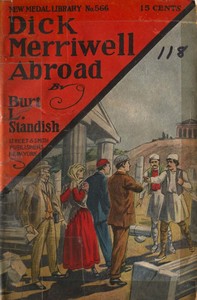
The source record for Dick Merriwell Abroad; Or, The Ban of the Terrible Ten — Reading Notes measures this digital text at 70,689 words, 5 hr 8 min estimated reading time, and 7 detected text sections.
The text analysis averages about 12.2 words per sentence, while the detected sections provide another way to judge how the source is divided.
Project Gutenberg metadata also associates the work with “Adventure stories,” connecting these edition facts with the source record’s subject description.
Explore this collection
These alternatives are selected using recorded categories and estimated reading time.
About 280 minutes
Young Readers
64,218 recorded words. 28 minutes difference from this book's estimate.
View Gutenberg source #41512About 231 minutes
Young Readers
52,999 recorded words. 77 minutes difference from this book's estimate.
View Gutenberg source #41628About 225 minutes
Young Readers
51,670 recorded words. 83 minutes difference from this book's estimate.
View Gutenberg source #42102Search stored excerpts and compare books → Choose by your preferences →
Choices use stored catalog measurements. Estimates vary with reading speed. A shared category is a catalog label, not a claim that two books have the same argument or literary quality.
Search reads excerpt text stored with this catalog and links to its associated Gutenberg record. The connection is stored in the site database; this tool does not recheck that every excerpt is word-for-word identical to that external record. Excerpt search does not cover every chapter and does not verify historical publication dates.
Catalog snapshot checked: 2026-09-26. Coverage: 90 public books, 90 available source excerpts.
Calculated from edition completeness, EPUB availability, text structure and catalogue metadata. Not a user rating.
Total of 100 points, scaled to a 2.5-5.0 range. Editions with an empty description or a missing EPUB file are not scored.
Public-domain source text
The source text is kept in the dedicated reader, separate from this catalogue record and its commentary.
The story opens in Edinburgh, where Professor Zenas Gunn delivers a buoyant lecture on Scottish history—Wallace, Bruce, Scott, Burns—while his young companion Brad Buckhart wears “an expression of disappointment” and “a slight cloud of gloom.” This early contrast between the professor’s eager backward-looking and Brad’s silent discontent sets a pattern: the narrative repeatedly pairs scenic, educational travel with undercurrents of unease. The party’s visit to Holyrood Castle and planned excursions to Melrose, Loch Lomond, and Bannockburn are framed as a tour of romantic landmarks, but the text’s real energy lies in moments when that tour is interrupted.
Later, in Venice, the same tension sharpens. The gondolier Reggio, chosen by Dick for his “honor and sincerity,” suddenly veers into dark canals, his face “pale and set,” his eyes “glowing with strange terror.” The professor and Brad suspect madness or robbery, but Dick insists on trust. The excerpt offers no resolution—only a chase through narrow waterways, moonlight, and the sense of something unseen pursuing them.
The professor’s speech is a catalogue of heroic names and sites: “the Wallace Monument, which stands on the spot where the great hero defeated England’s army of invasion.” His enthusiasm is almost theatrical, punctuated by “Hum! ha! Ha! hum!” Yet the narrative undercuts this with Brad’s “cloud of gloom” and Dick’s quiet observation of Reggio’s agitation. The professor himself later admits he is “inclined to look backward instead of forward,” a confession that aligns him with the very historical nostalgia he celebrates. Meanwhile, the gondolier’s terror is entirely present-tense, wordless, and physical. The text thus sets two modes of experiencing place against each other: one verbal, historical, and backward-looking; the other silent, immediate, and fearful.
Reggio’s behavior in Venice is the story’s most vivid set piece. He “seemed fleeing before something of which he was in mortal terror,” yet neither Dick nor the reader sees what he fears. The narrative withholds the threat, focusing instead on the reactions of the three travelers. Brad calls Reggio “bughouse” and “luny”; the professor mutters about “banded thieves”; but Dick insists on the gondolier’s trustworthiness, having chosen him for “honor and sincerity.” This disagreement among the party—between rational suspicion and intuitive trust—mirrors a broader pattern in the excerpts: characters interpret ambiguous events through their own predispositions. The chase through “very dark and very narrow” canals, the rhythmic sway of Reggio’s body, and the final glide back onto the Grand Canal create a sequence of mounting tension that is never explained within the provided text.
The two settings are sharply opposed. Edinburgh is described with “nipping cold,” a “light fall of snow,” and “clear air” that contrasts with London’s “heavy, smoky atmosphere.” The professor’s itinerary is full of open, named places: Scott’s monument, Melrose Abbey, Loch Lomond, Stirling. Venice, by contrast, is a labyrinth of “dark and very narrow” canals, where the party moves in shadow and moonlight, avoiding other gondolas. The open, historical landscape of Scotland gives way to the enclosed, secretive waterways of Venice. This shift from broad vistas to constricted passages mirrors the story’s move from public, educational travel to private, unexplained danger. The physical environment itself becomes a source of tension: the narrow canal is a trap, the moonlight a revealing but unreliable light.
Readers should attend to the way the narrative builds suspense through what it does not explain. The gondolier’s terror, the “Terrible Ten” of the title, and the hints of a secret society are introduced but left unresolved in these excerpts. The story’s pleasure lies less in the historical digressions than in the moments when those digressions are broken by sudden, unexplained action. Pay particular attention to the characters’ differing ways of reading the world: the professor through books, Brad through suspicion, Dick through trust in faces.
Reading about Dick’s unease beneath Venice’s painted canals, I felt that familiar tug toward another story where quiet tension hums under everyday life. There’s something about a threat that stays half-hidden—a whisper rather than a shout—that lingers long after the page turns. It reminded me of The Silent Alarm — A Closer Reading, where the stillness itself seems to hold its breath.
Your answers remain private and are stored only in this browser.