About 185 minutes
Dan Carter and the Cub Honor — Background and Themes
Young Readers
42,338 recorded words. 7 minutes difference from this book's estimate.
View Gutenberg source #40721
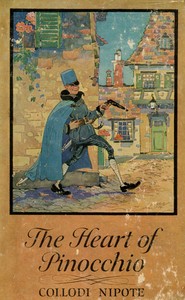
The catalog record for The Heart of Pinocchio: New Adventures of the Celebrated Little Puppet — Context and Discussion provides practical reading context through 40,771 words, 2 hr 58 min estimated reading time, and 5 detected text sections.
The text analysis averages about 16.2 words per sentence, while the detected sections provide another way to judge how the source is divided.
Project Gutenberg metadata also associates the work with “Puppets -- Juvenile fiction,” connecting these edition facts with the source record’s subject description.
Explore this collection
These alternatives are selected using recorded categories and estimated reading time.
About 185 minutes
Young Readers
42,338 recorded words. 7 minutes difference from this book's estimate.
View Gutenberg source #40721About 170 minutes
Young Readers
39,089 recorded words. 8 minutes difference from this book's estimate.
View Gutenberg source #40663About 170 minutes
Young Readers
38,871 recorded words. 8 minutes difference from this book's estimate.
View Gutenberg source #41260Search stored excerpts and compare books → Choose by your preferences →
Choices use stored catalog measurements. Estimates vary with reading speed. A shared category is a catalog label, not a claim that two books have the same argument or literary quality.
Search reads excerpt text stored with this catalog and links to its associated Gutenberg record. The connection is stored in the site database; this tool does not recheck that every excerpt is word-for-word identical to that external record. Excerpt search does not cover every chapter and does not verify historical publication dates.
Catalog snapshot checked: 2026-09-26. Coverage: 90 public books, 90 available source excerpts.
Calculated from edition completeness, EPUB availability, text structure and catalogue metadata. Not a user rating.
Total of 100 points, scaled to a 2.5-5.0 range. Editions with an empty description or a missing EPUB file are not scored.
Public-domain source text
The source text is kept in the dedicated reader, separate from this catalogue record and its commentary.
Collodi Nipote's The Heart of Pinocchio (1919) opens with a premise that immediately subverts the original: Pinocchio discovers he has a heart and has become a real boy—yet he soon finds himself longing for his wooden body. The author, Paolo Lorenzini (nephew of Carlo Collodi), transplants the puppet into the Italian front lines of World War I, where Pinocchio serves as an orderly to Captain Teschisso. The narrative voice retains the cheeky, literal-minded tone of the original, but the setting introduces a stark contrast between fairy-tale logic and the brutal realities of mountain warfare.
The dialogue in the excerpts reveals a Pinocchio who speaks with the same stubborn, self-interested cadence as Collodi’s character, but now directed at military authority. When Captain Teschisso threatens that a blizzard will freeze him “hard like Neapolitan ice-cream,” Pinocchio retorts not with fear but with a complaint about hunger: “Is it my fault if the air of these mountains makes me as hungry as a wolf?” The puppet’s logic remains transactional—he refuses to march unless fed—and his threats are absurdly grandiose, as when he vows to write to the King to have a major’s head cut off “or some other organ” in exchange for a leg. This diction preserves the original’s blend of childish petulance and cunning, but places it in a context where such behavior is both comic and dangerously out of step.
Pinocchio’s wooden leg—a detail carried over from the original—becomes a recurring motif. In Chapter VII, he “whirled his leg around” to win the respect of the garrison, and earlier he is described as having “a wooden leg and is as hardy as a goat.” The author uses the puppet’s artificial limb as a source of both humor and practical advantage: it can be spun for show, and it makes him impervious to cold that would cripple flesh-and-blood soldiers. Yet the text also hints at a downside: when Pinocchio tries to pirouette in the snow, he slips and slides down a mountain slope, his wooden body offering no grip. This duality—the wooden body as both asset and liability—is a structural choice that ties the fantastical premise to the physical challenges of the Alpine front.
The author consistently filters military reality through Pinocchio’s naive perspective. The enemy is referred to as “those dogs of Austrians,” and the captain speaks of eating Austrians as a joke about hunger. The censor’s marks—repeated blanks for place names like “Fort —— (censor)”—are left visible, drawing attention to the wartime constraints on the text itself. Pinocchio’s reaction to the idea of marching “in the clouds” is incredulity: “Do I really seem to you as much of a fool as that?” This literal-mindedness turns the sublime landscape of the Alps into a stage for farce. The juxtaposition of fairy-tale logic with the grim details of rations, snow, and altitude creates a tonal dissonance that is the book’s central stylistic gambit.
Virginia Watson’s translation preserves the colloquial, slightly archaic flavor of the Italian original. The dialogue is peppered with exclamations (“Heavens!”, “Bah!”) and the narrative voice shifts between formal description and direct address (“If you had come across him unexpectedly … you would not have recognized him”). The frequent ellipses noted by the transcriber suggest a breathless, oral quality in the source text. Watson also retains the author’s habit of breaking into lists (the contents of Pinocchio’s rations: “two rations of bread, a box of conserved beef, nearly half a pound of chocolate”) that ground the fantasy in concrete detail. These choices indicate a deliberate effort to keep the puppet’s voice recognizably Pinocchio-like while adapting it to a new, harsher landscape.
Readers coming from Collodi’s original will find a familiar protagonist dropped into an unfamiliar war. The book does not explain how Pinocchio came to be a soldier, nor does it resolve the tension between his wooden nature and his newfound heart. The excerpts suggest a narrative that leans heavily on dialogue and physical comedy, with the Alpine setting providing both obstacles and absurdities. Approach this sequel as a period curiosity—one that uses a beloved character to refract the experience of World War I through a deliberately childish, irreverent lens.
I remember reading this sequel and feeling how strange it is that a wooden puppet, so childlike in his mischief, carries wounded soldiers through the Alpine snow. It stirred something about duty wearing a childish face. Later, that same quiet ache returned in Dan Carter-- Cub Scout — Context and Discussion, where smallness meets circumstances far larger than any uniform. Childhood earnestness against a great, indifferent world—maybe that’s the thread.
Capture what you thought, learned, and would like to remember.