About 176 minutes
The Haunted Fountain A Judy Bolton Mystery — Key Ideas to Explore
Childrens Adventures
40,374 recorded words. 3 minutes difference from this book's estimate.
View Gutenberg source #47841
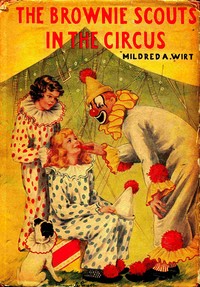
This digital edition of The Brownie Scouts in the Circus — Key Ideas to Explore is described by source-level measurements including 39,725 words, 2 hr 53 min estimated reading time, and 19 detected text sections.
The text analysis averages about 10.9 words per sentence, while the detected sections provide another way to judge how the source is divided.
Project Gutenberg metadata also associates the work with “Detective and mystery stories,” connecting these edition facts with the source record’s subject description.
Explore this collection
These alternatives are selected using recorded categories and estimated reading time.
About 176 minutes
Childrens Adventures
40,374 recorded words. 3 minutes difference from this book's estimate.
View Gutenberg source #47841About 179 minutes
Childrens Adventures
41,088 recorded words. 6 minutes difference from this book's estimate.
View Gutenberg source #50604About 181 minutes
Childrens Adventures
41,475 recorded words. 8 minutes difference from this book's estimate.
View Gutenberg source #45397Search stored excerpts and compare books → Choose by your preferences →
Choices use stored catalog measurements. Estimates vary with reading speed. A shared category is a catalog label, not a claim that two books have the same argument or literary quality.
Search reads excerpt text stored with this catalog and links to its associated Gutenberg record. The connection is stored in the site database; this tool does not recheck that every excerpt is word-for-word identical to that external record. Excerpt search does not cover every chapter and does not verify historical publication dates.
Catalog snapshot checked: 2026-09-26. Coverage: 90 public books, 90 available source excerpts.
Calculated from edition completeness, EPUB availability, text structure and catalogue metadata. Not a user rating.
Total of 100 points, scaled to a 2.5-5.0 range. Editions with an empty description or a missing EPUB file are not scored.
Public-domain source text
The source text is kept in the dedicated reader, separate from this catalogue record and its commentary.
From the first page, the Brownie Scouts’ world is built on routine and order: weekly meetings on Connie’s front porch, a planned hike to Pearson Ravine, and a leader who checks supplies. Yet the narrative immediately undercuts this stability. Veve McGuire is perpetually late, Jane Tuttle’s “saucy” tongue disrupts politeness, and the troop’s hike is merely a prelude to a far less controlled adventure. The excerpts show a pattern of careful structure—chapter titles, orderly files of girls, detailed descriptions of knapsacks and tin cans—colliding with impulsive, unsupervised choices. This tension between the Brownie code of “think before you act” and the lure of the unknown drives the story forward.
The dialogue in the excerpts reveals distinct personalities through word choice and rhythm. Veve speaks in breathless, short sentences: “Am I late, girls?” and “I’m so hungry I scarcely can wait.” Jane’s replies are drawn out and teasing: “What a question! Aren’t you always late?” Connie’s speech is more measured and responsible, often softening criticism with a “friendly smile.” Miss Gordon’s lines are brisk and cheerful, maintaining authority without sternness. These vocal contrasts create a lively group dynamic where each girl’s role—the impulsive one, the saucy one, the steady one—is established quickly. The narrator also uses physical details to reinforce character: Jane’s “pert red ribbons on her long yellow pigtails” and Connie’s “deep blue eyes, curly blond hair” and growing uniform. These descriptions are not mere decoration; they anchor the characters in a visual, middle-class domestic world that makes the later confinement in a dark box car feel especially jarring.
The narrative builds suspense through a careful sequence of sensory details. When Veve and Connie are locked in the box car, the text shifts from outdoor action to a confined, dark space. The description moves from the girls’ physical actions—beating on the door, screaming—to the sounds of the train: “hissing,” “chunk-chunk,” “clickity-click.” Each sound marks a stage of irreversible departure. The author repeats key phrases for emphasis: “Let us out! Let us out!” and “How will we ever get back?” The limited light through a “small ventilator door” and the “hazy” shapes of canvas bundles heighten the claustrophobia. The girls’ dialogue becomes a litany of regret, with Connie directly invoking the Brownie rule: “Miss Gordon’s told us a thousand times that Brownies THINK before they act.” This structural pattern—order, disruption, confinement, escalating fear—is a recurring device in the excerpts, and it suggests the full book will alternate between the safety of the troop and the peril of the circus.
The opening setting is meticulously detailed: a “curving walk,” a “front porch” with a “creaking porch swing,” a “natural park one mile beyond the outskirts of Rosedale.” These are familiar, safe spaces. In contrast, the circus train is defined by absence—no light, no people, no control. The box car is described only by its contents (“canvas bundles and boxes”) and its sounds. The girls’ homes are evoked as a lost paradise: “The nice house in Rosedale with its green lawn and trees seemed a million miles away.” The circus itself is never seen in the excerpts, only hinted at through the train and a “circus man” who locks the door. This asymmetry—the known, orderly world of Rosedale versus the unknown, mobile world of the circus—creates a central tension. The Brownie Scouts’ identity is tied to their troop and their town; being carried away by train strips them of both, leaving only their resourcefulness and each other.
Readers will notice how the author uses the Brownie Scout framework—rules, uniforms, troop hierarchy—not as a static backdrop but as a source of dramatic irony. The girls repeatedly fail to follow the very principles they are taught, and each failure propels the plot. Pay attention to how the narrator balances the girls’ fear with moments of resilience, and how the circus setting, once reached, may challenge or reinforce the values of the troop. The excerpts offer a tight, suspenseful sample of a larger pattern: order disrupted, then restored—but never quite the same.
I keep thinking about how Veve and Connie slipped beyond the safety of their troop, letting curiosity carry them somewhere loud and unfamiliar. It reminded me of another quiet ache in Crossed Trails in Mexico Mexican Mystery Stories #3 — Background and Themes, where that same pull between known paths and unknown ones lingers softly, long after the last page turns.
Your answers remain private and are stored only in this browser.