About 276 minutes
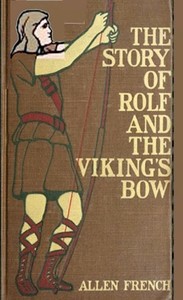
The Story of Rolf and the Viking's Bow — Text and Context
School Stories
63,380 recorded words. 4 minutes difference from this book's estimate.
View Gutenberg source #43381
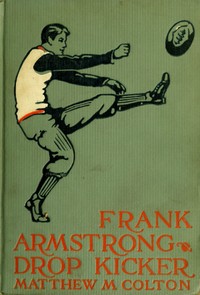
The source record for Frank Armstrong, Drop Kicker — Text and Context measures this digital text at 62,419 words, 4 hr 32 min estimated reading time, and 7 detected text sections.
The text analysis averages about 15.0 words per sentence, while the detected sections provide another way to judge how the source is divided.
Project Gutenberg metadata also associates the work with “Football -- Juvenile fiction,” connecting these edition facts with the source record’s subject description.
Explore this collection
These alternatives are selected using recorded categories and estimated reading time.
About 276 minutes
School Stories
63,380 recorded words. 4 minutes difference from this book's estimate.
View Gutenberg source #43381About 223 minutes
School Stories
51,201 recorded words. 49 minutes difference from this book's estimate.
View Gutenberg source #43362About 221 minutes
School Stories
50,723 recorded words. 51 minutes difference from this book's estimate.
View Gutenberg source #46872Search stored excerpts and compare books → Choose by your preferences →
Choices use stored catalog measurements. Estimates vary with reading speed. A shared category is a catalog label, not a claim that two books have the same argument or literary quality.
Search reads excerpt text stored with this catalog and links to its associated Gutenberg record. The connection is stored in the site database; this tool does not recheck that every excerpt is word-for-word identical to that external record. Excerpt search does not cover every chapter and does not verify historical publication dates.
Catalog snapshot checked: 2026-09-26. Coverage: 90 public books, 90 available source excerpts.
Calculated from edition completeness, EPUB availability, text structure and catalogue metadata. Not a user rating.
Total of 100 points, scaled to a 2.5-5.0 range. Editions with an empty description or a missing EPUB file are not scored.
Public-domain source text
The source text is kept in the dedicated reader, separate from this catalogue record and its commentary.
The opening chapter of Frank Armstrong, Drop Kicker establishes a deliberate, almost drowsy pace. The narrative lingers on a July afternoon at Seawall, describing a sloop at anchor, a motionless sea, and the Ancient Mariner nodding with his pipe hanging on his chest. The prose itself seems to take a siesta, with long sentences and gentle verbs like “swaying idly” and “wrinkled for a moment.” This calm is abruptly punctured when three swimmers approach the boat and one tweaks the old man’s finger. The shift from stillness to sudden motion—the Ancient “instantly” in motion, the “seal” disappearing—introduces a pattern of alternating quiet and action that recurs throughout the excerpts.
The narrative voice in the opening chapter is unhurried, almost painterly, as it sets the scene. Details accumulate: the “milk-white mainsail,” the “mirror-like surface,” the old man’s “toil-worn hand.” The pace is languid until the moment of tweaking, when the prose snaps into short, quick clauses: “Instantly the Ancient was in motion and the ‘seal’ disappeared below the surface in a twinkling.” This technique of building a static tableau and then shattering it with a burst of movement recurs later. In the football practice scene, the description of Jimmy’s playing style is similarly compact and energetic: “Wherever the ball was, there might be found Jimmy’s flaming top-knot.” The contrast between the opening’s descriptive calm and the later instructional scenes—where dialogue and physical comedy accelerate the rhythm—shows Colton’s willingness to modulate pace for effect.
The football lesson in the study is a set piece that relies on rapid-fire dialogue and slapstick. Jimmy’s commands are terse and urgent: “Now, Lewis, you are the opposing guard. Stand here.” The responses from Lewis and the Codfish are comic deflations: “It’s a pleasant job, how much do I get?” and “Where’s the automobile that hit me?” The action is described in a series of short, kinetic sentences: “Over they went like nine pins, Lewis fetching up in the fireplace and the Codfish under the window seat!” The humor arises from the contrast between Jimmy’s earnestness and the players’ physical indignities. The Codfish’s complaint about his “immaculate clothes” being “mussed up” reinforces the class-consciousness of the setting. This scene demonstrates how Colton uses dialogue not just to advance the plot but to characterize through voice—Jimmy’s focused intensity, the Codfish’s dandyish irritation, Lewis’s deadpan groan.
Several details recur across the excerpts, suggesting deliberate structural patterning. The motif of hands appears: the Ancient Mariner’s “toil-worn hand” hanging over the gunwale, and later Frank’s need to learn “to handle the ball quickly without fumbling it.” The image of a hand as a point of contact—tweaked, then trained—links the opening’s idle moment to the later disciplined practice. Water also recurs: the swimmers in the bay, the “swim for life” chapter title, and the water carnival. Even the football drill is framed as a kind of aquatic movement—the Codfish “edging away” like a swimmer. The narrative voice itself shifts between a detached, almost omniscient observer in the opening and a more intimate, dialogue-driven presence in the study. These echoes suggest that Colton is consciously weaving a fabric of repeated imagery, even if the excerpts do not reveal the full pattern.
Readers attentive to shifts in tempo will find that Colton’s prose rewards close attention to its rhythms. The opening’s leisurely description gives way to the staccato of football drills, and the comic dialogue of the study scene contrasts with the more straightforward action of later chapters. The excerpts hint at a work that balances pastoral calm with athletic intensity, and that uses recurring motifs—hands, water, sudden motion—to unify its episodes. Approach the text as a series of carefully paced scenes rather than a continuous narrative, and note how the voice adapts to each new setting.
There’s a particular quiet in the drop-kicker’s summer pages—that hush before the snap—that always reminds me of Fairview Boys and Their Rivals; or, Bob Bouncer's Schooldays — Background and Themes, where the same sunlit patience hides a sharper lesson underneath. Funny how those slow afternoons stay with us longer than the touchdowns ever do.
Save your reaction, strongest insight, and memorable passage.