About 272 minutes
Frank Armstrong, Drop Kicker — Text and Context
School Stories
62,419 recorded words. 4 minutes difference from this book's estimate.
View Gutenberg source #48849
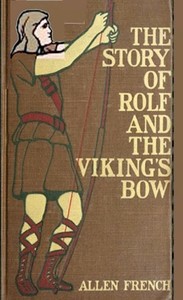
Before opening The Story of Rolf and the Viking's Bow — Text and Context, the edition data offers a quick orientation: 63,380 words, 4 hr 36 min estimated reading time, and 7 detected text sections.
The text analysis averages about 16.8 words per sentence, while the detected sections provide another way to judge how the source is divided.
Project Gutenberg metadata also associates the work with “Vikings -- Juvenile fiction,” connecting these edition facts with the source record’s subject description.
Explore this collection
These alternatives are selected using recorded categories and estimated reading time.
About 272 minutes
School Stories
62,419 recorded words. 4 minutes difference from this book's estimate.
View Gutenberg source #48849About 223 minutes
School Stories
51,201 recorded words. 53 minutes difference from this book's estimate.
View Gutenberg source #43362About 221 minutes
School Stories
50,723 recorded words. 55 minutes difference from this book's estimate.
View Gutenberg source #46872Search stored excerpts and compare books → Choose by your preferences →
Choices use stored catalog measurements. Estimates vary with reading speed. A shared category is a catalog label, not a claim that two books have the same argument or literary quality.
Search reads excerpt text stored with this catalog and links to its associated Gutenberg record. The connection is stored in the site database; this tool does not recheck that every excerpt is word-for-word identical to that external record. Excerpt search does not cover every chapter and does not verify historical publication dates.
Catalog snapshot checked: 2026-09-26. Coverage: 90 public books, 90 available source excerpts.
Calculated from edition completeness, EPUB availability, text structure and catalogue metadata. Not a user rating.
Total of 100 points, scaled to a 2.5-5.0 range. Editions with an empty description or a missing EPUB file are not scored.
Public-domain source text
The source text is kept in the dedicated reader, separate from this catalogue record and its commentary.
The novel opens with a blizzard that tests judgment and obedience. Rolf, silent all afternoon, warns of snow; his elder Grani dismisses him. The storm swallows the land, a guide falls to his death, and the party huddles in a snowdrift. This scene establishes two patterns: nature as an unforgiving force, and Rolf’s quiet competence against Grani’s stubborn command. The prose is lean, driven by dialogue and action—no interior reflection. Readers should watch how these early dynamics of voice and silence recur.
The excerpt’s first exchange is terse: “Lead forward!” says Grani to the shepherd. Rolf has been silent all afternoon, yet when he speaks it is to urge retreat. His warnings are factual—“Not fog is that, but snow”—and ignored. Grani’s replies are dismissive: “Wilt thou never be silent?” The dialogue carries the conflict without commentary. This pattern of a protagonist who speaks little but accurately, set against a louder authority, is a structural clue for the whole narrative. In saga tradition, words are deeds; Rolf’s few lines carry weight.
The storm is not merely weather but a test of character. The shepherd leads; Grani commands; Rolf warns; Frodi acts. When the guide falls, Frodi “clutched at him, but caught only the cloak”—a detail that shows both instinct and failure. The group’s survival depends on Rolf’s sense of direction, not Grani’s orders. The snow heaps around them, and Grani’s regrets (“I am sorry we turned not back”) come too late. The landscape is indifferent, but the author uses it to expose who sees clearly and who does not. This is a world where physical endurance and practical wisdom are the only virtues that matter.
French’s preface explicitly names the Icelandic sagas—Njal’s Saga, Grettir’s Saga, Ere-Dwellers’ Saga—as his sources. He notes that “the spirit of those days is particularly well given” in a fragment of Thorstein Staffsmitten, which supplied his closing incidents. The main plot, he says, came from a footnote in the Ere-Dwellers’ Saga. This is not a modern fantasy but a deliberate reconstruction of medieval Icelandic storytelling. Readers familiar with the sagas will recognize the clipped dialogue, the focus on legal and domestic conflict, and the matter-of-fact violence. Those new to the genre should expect a narrative that values action over psychology.
The provided text breaks off mid-scene, with Grani shivering and the group trapped. We do not learn how they escape, or whether the bow of the title appears. The catalog subjects—Vikings, heroes, archers, Iceland’s history to 1262—suggest a broader arc of conflict and skill, but the opening focuses on survival and hierarchy. The bow itself is not mentioned in the excerpt. A first reader should note that the novel’s title promises a weapon, but the early pages establish a world where tools are less important than judgment. The bow may be a symbol of maturity or a plot device; the excerpts do not reveal which.
This novel rewards attention to small details: a broken cloak clasp, a shift in walking order, a single line of dialogue. French’s prose is economical, and every word serves the story. If the opening blizzard feels like a microcosm of the whole—a test of wills against an indifferent environment—that is by design. Read with an eye for who speaks, who acts, and who is silent.
That opening blizzard in The Story of Rolf and the Viking's Bow brought back the hush of a snowed-in afternoon when I first read about a different kind of stubbornness—a small girl learning to be brave among strangers. Dotty Dimple at School — Key Ideas to Explore gave me that same warm ache of watching someone find their footing, one quiet step at a time.
Your answers remain private and are stored only in this browser.