About 215 minutes
Dick Kent with the Mounted Police — Text and Context
Childrens Adventures
49,223 recorded words. 2 minutes difference from this book's estimate.
View Gutenberg source #50431
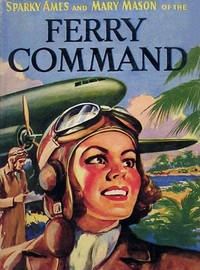
For Sparky Ames of the Ferry Command — Inside the Classic, the stored edition analysis reports 49,816 words, 3 hr 37 min estimated reading time, and 8 detected text sections.
The text analysis averages about 10.6 words per sentence, while the detected sections provide another way to judge how the source is divided.
Project Gutenberg metadata also associates the work with “War stories,” connecting these edition facts with the source record’s subject description.
Explore this collection
These alternatives are selected using recorded categories and estimated reading time.
About 215 minutes
Childrens Adventures
49,223 recorded words. 2 minutes difference from this book's estimate.
View Gutenberg source #50431About 210 minutes
Childrens Adventures
48,229 recorded words. 7 minutes difference from this book's estimate.
View Gutenberg source #44013About 209 minutes
Childrens Adventures
47,958 recorded words. 8 minutes difference from this book's estimate.
View Gutenberg source #45485Search stored excerpts and compare books → Choose by your preferences →
Choices use stored catalog measurements. Estimates vary with reading speed. A shared category is a catalog label, not a claim that two books have the same argument or literary quality.
Search reads excerpt text stored with this catalog and links to its associated Gutenberg record. The connection is stored in the site database; this tool does not recheck that every excerpt is word-for-word identical to that external record. Excerpt search does not cover every chapter and does not verify historical publication dates.
Catalog snapshot checked: 2026-09-26. Coverage: 90 public books, 90 available source excerpts.
Calculated from edition completeness, EPUB availability, text structure and catalogue metadata. Not a user rating.
Total of 100 points, scaled to a 2.5-5.0 range. Editions with an empty description or a missing EPUB file are not scored.
Public-domain source text
The source text is kept in the dedicated reader, separate from this catalogue record and its commentary.
The novel opens not with its human characters but with the sound of engines: 'the roar and thunder of many motors' beating down on the Brazilian jungle. Two natives in a dugout count the passing planes by snapping twigs—one per aircraft—until they reach forty. This small, precise ritual establishes a pattern that runs through the book: objects and gestures are made to carry meaning beyond their surface. A broken branch, a misplaced overnight bag, a roll of papyrus—each becomes a clue or a trap. Snell builds his story less on sustained action than on a chain of such charged details, moving his characters from one exotic setting to the next with the same steady, almost mechanical rhythm as those counting natives.
The opening scene’s twig-counting is not a throwaway color. It introduces a method: the world is full of signs that want decoding. Later, Mary discovers her bag has been swapped. The replacement contains brand-new clothes in her exact size, but the papyrus roll is gone. Her father speculates about enemy spies, Oriental robbers, and ancient writings worth 'many thousands.' The bag itself becomes a puzzle—who replaced it, and why so carefully? Snell does not resolve these questions quickly. Instead, he lets the mystery sit, like the broken branches in the canoe, while the characters move on to a Persian garden party. The effect is cumulative: each chapter adds another object or encounter that demands interpretation.
The story’s structure depends on rapid, almost cinematic shifts of location. From the Brazilian river, the narrative jumps to a Persian garden, then to a secret airfield, a bazaar, a cloudbank, a donkey ride. These transitions are often abrupt, bridged by a single sentence or a chapter break. The effect is less a continuous journey than a series of set pieces, each with its own local color and minor crisis. Snell uses movement itself as a source of tension: characters are always arriving or departing, and the reader is kept off balance, never sure what the next scene will demand. This episodic quality suits the serial origins of the book—it was published as part of Whitman’s 'Fighters for Freedom' series—and rewards attention to the way each new setting reconfigures the stakes.
Two images recur with enough frequency to function as structural anchors. The first is the roll of papyrus, an ancient object that may or may not contain a secret message. Mary’s father mentions men who 'will tell you how this war is to end' from reading the Koran or the Bible, but the papyrus itself remains offstage for long stretches. The second is the Lady in Black, a figure who appears in the illustrations and is named in a chapter title. The excerpts do not reveal her identity or role, but her repeated mention suggests she is a hinge point in the plot. Snell uses these images sparingly, letting them surface at intervals to remind the reader that beneath the travelogue lies a mystery plot built on delayed revelation.
The dialogue in the excerpts is notably flat and expository. Characters explain situations to each other in ways that feel designed for the reader’s benefit. When Mary says, 'This is not my bag!' and her father replies, 'It must be!' the exchange carries no subtext. Snell’s prose favors declarative sentences and simple constructions: 'The garden was all that he had promised, and more.' There is little interiority; emotions are stated rather than dramatized. This plainness is consistent with the book’s intended audience and its wartime purpose—clarity over ambiguity. But it also means that the novel’s interest lies almost entirely in its plot machinery and its settings, not in character psychology. Readers who enjoy puzzle-box narratives and period atmosphere will find more to work with than those seeking psychological depth.
Because the excerpts cover only the opening chapters and a later garden-party scene, the full shape of the mystery—especially the fate of the papyrus and the identity of the Lady in Black—remains unclear. Readers should approach the book as a period artifact: a wartime adventure that values incident over introspection. Pay attention to the chapter titles, which often telegraph the next puzzle, and to the illustrations, which may supply visual clues the text withholds. The novel rewards a patient, detail-oriented reading, one that treats each swapped bag and each passing plane as part of a larger pattern.
In Sparky Ames, Snell’s youth felt so urgent, yet rereading, I saw how his hero’s flight lines traced the same quiet maps of duty that carry Stanley P. Hall. That older courier shares this boy’s patience—not with pistols, but with wheels and hours. There’s a gentle fellowship between such earnest races and secret runs. I keep returning to both. Motor Matt's "Century" Run; or, The Governor's Courier — Text and Context sits beside it, worn smooth from the same fond hands.
Answer a few questions and save a private reflection on this device.