About 270 minutes
Vivian's Lesson — Context and Discussion
Childrens Adventures
61,974 recorded words. 1 minutes difference from this book's estimate.
View Gutenberg source #50659
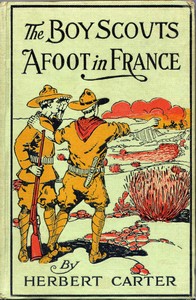
This digital edition of The Boy Scouts Afoot in France; or, With the Red Cross Corps at the Marne — Text and Context is described by source-level measurements including 62,257 words, 4 hr 31 min estimated reading time, and 8 detected text sections.
The text analysis averages about 22.3 words per sentence, while the detected sections provide another way to judge how the source is divided.
Project Gutenberg metadata also associates the work with “Boy Scouts -- Juvenile fiction,” connecting these edition facts with the source record’s subject description.
Explore this collection
These alternatives are selected using recorded categories and estimated reading time.
About 270 minutes
Childrens Adventures
61,974 recorded words. 1 minutes difference from this book's estimate.
View Gutenberg source #50659About 268 minutes
Childrens Adventures
61,614 recorded words. 3 minutes difference from this book's estimate.
View Gutenberg source #48379About 264 minutes
Childrens Adventures
60,552 recorded words. 7 minutes difference from this book's estimate.
View Gutenberg source #44954Search stored excerpts and compare books → Choose by your preferences →
Choices use stored catalog measurements. Estimates vary with reading speed. A shared category is a catalog label, not a claim that two books have the same argument or literary quality.
Search reads excerpt text stored with this catalog and links to its associated Gutenberg record. The connection is stored in the site database; this tool does not recheck that every excerpt is word-for-word identical to that external record. Excerpt search does not cover every chapter and does not verify historical publication dates.
Catalog snapshot checked: 2026-09-26. Coverage: 90 public books, 90 available source excerpts.
Calculated from edition completeness, EPUB availability, text structure and catalogue metadata. Not a user rating.
Total of 100 points, scaled to a 2.5-5.0 range. Editions with an empty description or a missing EPUB file are not scored.
Public-domain source text
The source text is kept in the dedicated reader, separate from this catalogue record and its commentary.
The story opens with the four scouts—Thad, Allan, Bumpus, and Giraffe—disembarking in Antwerp after a journey from Rotterdam. Bumpus is anxious to find his mother at a sanitarium, a personal errand that runs alongside the larger war. The dialogue-heavy style immediately establishes distinct voices: Thad as the steady leader, Bumpus as the fretful but good-natured member, and Giraffe as the quick-thinking one. The narrative voice often uses exclamations and tags like “of course” and “you know,” giving the prose a conversational, almost transcribed feel.
The excerpts rely heavily on spoken exchanges to advance the plot and reveal character. For instance, Bumpus’s worry about his mother is conveyed through direct speech: “I’m in a cold sweat for fear something may have happened.” Thad’s reply—“We all hope you’ll find her much improved”—shows his role as a calming influence. Later, when Bumpus gets lost, he reports his adventures in a single line: “I got lost, all right, just as Giraffe said I would.” The dialogue often includes interjections like “Oh!” and “Well,” and characters frequently address each other by nicknames (“Giraffe,” “Bumpus”). This technique keeps the pace brisk and mimics the spontaneity of real conversation, though it sometimes sacrifices descriptive depth.
The boys apply scout training to wartime situations. They dress wounds, stop bleeding, and arrange transport for an injured ambulance driver. Allan’s comment about a truck carrying “cause and effect” (ammunition going forward, wounded returning) shows an attempt to interpret war through a scout’s practical lens. The narrative emphasizes resourcefulness: the scouts bind the driver’s arm “with more or less skill” and flag down a van, negotiating space despite it being full. Thad’s plan to offer services to the Red Cross is presented as a natural extension of scout principles: “scouts always expect to make themselves useful as well as ornamental.” This framing aligns the adventure with the Boy Scout movement’s ideals of service and preparedness.
The war setting is rendered through brief, functional details rather than immersive description. The scouts land in Antwerp, travel through Belgium, and end up near the Marne, but the excerpts focus on immediate tasks—finding a vehicle, locating a sanitarium, helping a driver. The war intrudes via “motor trucks” carrying wounded and the mention of “field-hospital work.” Bumpus’s personal mission (reuniting with his mother) provides emotional weight, but the narrative does not dwell on the broader conflict. The setting serves as a stage for scouting adventures rather than a historically detailed backdrop. The catalog subjects list the Marne campaign, but the excerpts show only indirect contact with battle, through the aftermath of wounds and ambulance service.
Readers should note that the excerpts cover only the opening chapters and a later scene; the full novel likely includes more action and a resolution to Bumpus’s search. The catalog subjects emphasize the Red Cross and the Marne, but the excerpts show the scouts still en route to that service. The book’s value lies in its period portrayal of Boy Scout ideals applied to World War I, filtered through a formulaic adventure structure. Approach it as a historical artifact of wartime youth fiction rather than a detailed war chronicle.
That old Boy Scouts book, with its mud and field-bandages, left me thinking about how quiet duty feels next to a loud adventure. I remember that strange pull between wanting to help and wanting to go home. There’s a soft, wandering essay that touches that same ache, almost like a half-remembered campfire: The Sky Trail — Background and Themes. It lingered with me, the way that book did.
Build a private reading journal entry for this title.