About 271 minutes
The Boy Scouts Afoot in France; or, With the Red Cross Corps at the Marne — Text and Context
Childrens Adventures
62,257 recorded words. 1 minutes difference from this book's estimate.
View Gutenberg source #47358
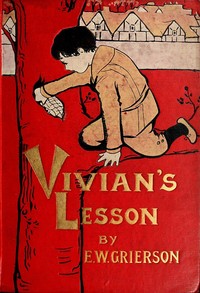
The catalog record for Vivian's Lesson — Context and Discussion provides practical reading context through 61,974 words, 4 hr 30 min estimated reading time, and 29 detected text sections.
The text analysis averages about 24.1 words per sentence, while the detected sections provide another way to judge how the source is divided.
Project Gutenberg metadata also associates the work with “Christian life -- Juvenile fiction,” connecting these edition facts with the source record’s subject description.
Explore this collection
These alternatives are selected using recorded categories and estimated reading time.
About 271 minutes
Childrens Adventures
62,257 recorded words. 1 minutes difference from this book's estimate.
View Gutenberg source #47358About 268 minutes
Childrens Adventures
61,614 recorded words. 2 minutes difference from this book's estimate.
View Gutenberg source #48379About 264 minutes
Childrens Adventures
60,552 recorded words. 6 minutes difference from this book's estimate.
View Gutenberg source #44954Search stored excerpts and compare books → Choose by your preferences →
Choices use stored catalog measurements. Estimates vary with reading speed. A shared category is a catalog label, not a claim that two books have the same argument or literary quality.
Search reads excerpt text stored with this catalog and links to its associated Gutenberg record. The connection is stored in the site database; this tool does not recheck that every excerpt is word-for-word identical to that external record. Excerpt search does not cover every chapter and does not verify historical publication dates.
Catalog snapshot checked: 2026-09-26. Coverage: 90 public books, 90 available source excerpts.
Calculated from edition completeness, EPUB availability, text structure and catalogue metadata. Not a user rating.
Total of 100 points, scaled to a 2.5-5.0 range. Editions with an empty description or a missing EPUB file are not scored.
Public-domain source text
The source text is kept in the dedicated reader, separate from this catalogue record and its commentary.
Elizabeth W. Grierson opens Vivian's Lesson with a scene on ice that immediately establishes character through dialogue. Vivian urges his brother Ronald to stay for “one turn more,” calling him “old stupid,” while Ronald hesitates, mindful of a promise to their mother. The exchange is brief but revealing: Vivian’s impulsive, coaxing tone contrasts with Ronald’s troubled obedience. Grierson does not narrate their personalities; she lets the spoken words and a single phrase—Ronald’s “troubled look on his face”—do the work. This economy of description, relying on dialogue and minimal physical detail, recurs throughout the excerpts, shaping a narrative voice that trusts readers to infer emotion from what is said and left unsaid.
Grierson frequently pairs dialogue with a precise physical action that amplifies or undercuts the spoken words. When Mrs. Armitage enters the sickroom, Ronald “jumped up in surprise and pulling her down beside him,” while Vivian “turned his face away from the table and burst into a torrent of loud, frightened sobs.” The father’s command—“You must control yourself, my boy”—is immediately countered by the mother’s silent gesture: she “stretched out her hand and drawn him gently to her.” These moments show Grierson using gesture as a counterpoint to speech, revealing tensions between discipline and comfort. The pattern holds in smaller exchanges: Vivian hides his face in his mother’s dress; she puts her hand on his head. Such tags are not decorative; they carry the emotional weight that the characters’ words often avoid.
Grierson’s diction oscillates between controlled, almost clinical language and sudden emotional outbursts. The medical crisis is described in detached terms: “inflammation had set in,” “the end could not be far off.” Yet within the same paragraph, Mrs. Armitage’s tears appear, and she tries “to speak as cheerfully as possible.” The contrast is deliberate. Vivian’s sobbing—a “torrent of loud, frightened sobs”—is the only raw release in a household where composure is expected. His father’s rebuke (“we cannot have a noise like that here”) underscores the social code. Grierson uses words like “troubled,” “anxious,” and “wearied” for the adults, while the children’s vocabulary is simpler: “good,” “thoughtful,” “frightened.” This lexical divide reinforces the hierarchy of age and authority, even as the narrative sympathizes with the child’s perspective.
The physical settings in the excerpts are sketched with just enough detail to reflect emotional states. The ice is a place of risk and disobedience; the sickroom is a space of hushed adult control. When Mrs. Armitate draws up a low chair to the fire and invites the boys to sit close, the hearth becomes a zone of intimacy and confession. Vivian chooses to sit on the floor, hiding his face in her dress—a spatial choice that signals shame and a desire for concealment. Grierson does not describe the room’s furnishings; she focuses on the arrangement of bodies around the fire. Later, the mother’s “soft gray gown” is the only color mentioned, a muted detail that contrasts with the emotional intensity. The setting functions not as backdrop but as a stage for unspoken negotiations of power and forgiveness.
Grierson withholds information strategically, creating gaps that the reader must fill. The cause of Isobel’s fall is not stated; the severity of her injury is revealed through oblique medical talk. When Ronald asks, “What does Uncle Jack say about Isobel?” his mother hesitates before answering, “She is very ill, dearie.” The hesitation itself communicates more than the words. Similarly, the brothers’ week-long absence from home is mentioned but not explained—the reader infers a crisis. This technique mirrors the children’s limited understanding: they overhear fragments, sense adult worry, and piece together meaning from tone and silence. Grierson’s narrative voice respects that partial knowledge, never over-explaining, and thereby keeps the reader aligned with the protagonists’ dawning comprehension.
Readers attentive to Grierson’s craft will notice how much she accomplishes through what is not said. The dialogue carries subtext; the gestures speak louder than commands. In Vivian’s Lesson, the lesson is not only Vivian’s but the reader’s: to watch for the moment when a character’s body contradicts their words, or when a pause in conversation reveals more than speech. This editorial note has focused on the opening chapters; the full novel may extend these patterns into broader adventures, but the foundation of Grierson’s style is laid in these early, quiet exchanges.
Reading how Grierson’s restrained diction lets the moral weight of a scene settle slowly reminded me of sitting with my grandmother, who used pauses the same way. That unhurried cadence came back when I read The Secret of Casa Grande Mexican Mystery Stories #1 — Themes and Context; both books leave room for the reader’s own quiet, without ever rushing the feeling.
Save your reaction, strongest insight, and memorable passage.