About 134 minutes
The Boy Scouts for City Improvement — A Closer Reading
Childrens Adventures
30,659 recorded words. 1 minutes difference from this book's estimate.
View Gutenberg source #49338
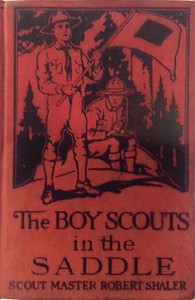
The source record for The Boy Scouts in the Saddle — Inside the Classic measures this digital text at 30,486 words, 2 hr 13 min estimated reading time, and 4 detected text sections.
The text analysis averages about 20.7 words per sentence, while the detected sections provide another way to judge how the source is divided.
Project Gutenberg metadata also associates the work with “Mystery and detective stories,” connecting these edition facts with the source record’s subject description.
Explore this collection
These alternatives are selected using recorded categories and estimated reading time.
About 134 minutes
Childrens Adventures
30,659 recorded words. 1 minutes difference from this book's estimate.
View Gutenberg source #49338About 129 minutes
Childrens Adventures
29,510 recorded words. 4 minutes difference from this book's estimate.
View Gutenberg source #48410About 126 minutes
Childrens Adventures
28,862 recorded words. 7 minutes difference from this book's estimate.
View Gutenberg source #44731Search stored excerpts and compare books → Choose by your preferences →
Choices use stored catalog measurements. Estimates vary with reading speed. A shared category is a catalog label, not a claim that two books have the same argument or literary quality.
Search reads excerpt text stored with this catalog and links to its associated Gutenberg record. The connection is stored in the site database; this tool does not recheck that every excerpt is word-for-word identical to that external record. Excerpt search does not cover every chapter and does not verify historical publication dates.
Catalog snapshot checked: 2026-09-26. Coverage: 90 public books, 90 available source excerpts.
Calculated from edition completeness, EPUB availability, text structure and catalogue metadata. Not a user rating.
Total of 100 points, scaled to a 2.5-5.0 range. Editions with an empty description or a missing EPUB file are not scored.
Public-domain source text
The source text is kept in the dedicated reader, separate from this catalogue record and its commentary.
The opening chapter introduces Gustavus Merrivale, a wealthy newcomer who expects service and addresses a tavern keeper as "landlord." His demand for gasoline on credit and mention of his father's quarry establish a character defined by privilege and arrogance. The narrative voice, however, undercuts him: he is "inclined to be rather arrogant" and "more or less proud, and domineering." This direct characterization sets up a tension between Gusty's self-regard and the scout values of resourcefulness and humility that the story will test.
The excerpt centers on a tracking sequence after Gusty's stolen runabout is found abandoned. Patrol leader Hugh Hardin reads the ground: footprints lead into the woods, not along the road, indicating the thieves knew a shortcut to a hiding place. Hugh's methodical examination—"bending down and examining the surrounding earth"—contrasts with Gusty's earlier carelessness. The boys disable their vehicles before proceeding, a practical precaution that Gusty, who had previously "laughed scornfully" at taking orders, now follows without protest.
The tracking itself is a lesson in observation. Hugh points out "faint indications of footprints" to Gusty, who admits he would have made "a sorry mess of it" alone. This moment of self-awareness marks a shift: his pride is touched, and he resolves to learn scoutcraft, even considering organizing his own patrol. The physical setting—an "old abandoned road all grown up with grass and briars"—reinforces the theme of hidden paths and reclaimed knowledge.
Robert Shaler uses dialogue to delineate character. Gusty's speech is imperious: "charge it to dad" and "I reckon there'd be a lot of trouble... if Gusty Merrivale failed to show up." The tavern keeper, by contrast, "putting two and two together," understands the situation without being told. The scouts speak in practical, cooperative tones—"We can fix that all right"—and their leader, Hugh, offers guidance without condescension.
The social hierarchy is explicit. Gusty picks companions from the "upper crust" and looks down on Billy Worth as "rather stupid." Yet the narrative rewards competence over class: Hugh's tracking skill earns Gusty's grudging respect. The phrase "it galled his pride to have to depend on anyone else for information" captures the central tension between inherited status and earned ability.
The excerpt moves from a static introduction—Gusty's arrival and characterization—to a dynamic chase sequence. The shift occurs when the stolen car is discovered, accelerating the pace. Shaler uses short paragraphs and frequent dialogue to maintain momentum. Action is broken by moments of reflection, as when Gusty mentally catalogues his deficiencies.
The chapter title, "The Superior Boy," is ironic: Gusty's superiority is social, not practical. The narrative structure reinforces this by placing him in situations where his assumptions fail. The tracking scene, with its careful attention to footprints and terrain, exemplifies the scoutcraft that the series promotes. The abandoned road as a destination suggests that the thieves, like Gusty, are following paths that are no longer obvious.
Readers should attend to how Shaler balances instruction with adventure. The tracking sequence is both a plot device and a demonstration of practical skills—reading footprints, disabling vehicles, moving silently. Gusty's arc from arrogance to humility is sketched through small gestures, not dramatic conversion. The excerpt rewards attention to detail: the abandoned road, the "faint indications of footprints," and the contrast between Gusty's initial bluster and his later quiet admission of ignorance.
Reading about Hugh and Gusty trading pride for footprints in the woods, I kept thinking of The Boy Scouts for City Improvement — A Closer Reading. Both books seem to ask the same quiet question—what a scout becomes when the trail leads not away from town, but straight through its own back alleys. The saddle and the sidewalk, somehow, share that same patient lesson.
Save your reaction, strongest insight, and memorable passage.