About 126 minutes
Nabul, Our Little Egyptian Cousin — Background and Themes
Childrens Adventures
28,862 recorded words. 3 minutes difference from this book's estimate.
View Gutenberg source #44731
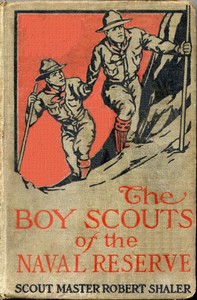
The catalog record for The Boy Scouts of the Naval Reserve — Key Ideas to Explore provides practical reading context through 29,510 words, 2 hr 9 min estimated reading time, and 4 detected text sections.
The text analysis averages about 22.1 words per sentence, while the detected sections provide another way to judge how the source is divided.
Project Gutenberg metadata also associates the work with “Mystery and detective stories,” connecting these edition facts with the source record’s subject description.
Explore this collection
These alternatives are selected using recorded categories and estimated reading time.
About 126 minutes
Childrens Adventures
28,862 recorded words. 3 minutes difference from this book's estimate.
View Gutenberg source #44731About 133 minutes
Childrens Adventures
30,486 recorded words. 4 minutes difference from this book's estimate.
View Gutenberg source #49269About 134 minutes
Childrens Adventures
30,659 recorded words. 5 minutes difference from this book's estimate.
View Gutenberg source #49338Search stored excerpts and compare books → Choose by your preferences →
Choices use stored catalog measurements. Estimates vary with reading speed. A shared category is a catalog label, not a claim that two books have the same argument or literary quality.
Search reads excerpt text stored with this catalog and links to its associated Gutenberg record. The connection is stored in the site database; this tool does not recheck that every excerpt is word-for-word identical to that external record. Excerpt search does not cover every chapter and does not verify historical publication dates.
Catalog snapshot checked: 2026-09-26. Coverage: 90 public books, 90 available source excerpts.
Calculated from edition completeness, EPUB availability, text structure and catalogue metadata. Not a user rating.
Total of 100 points, scaled to a 2.5-5.0 range. Editions with an empty description or a missing EPUB file are not scored.
Public-domain source text
The source text is kept in the dedicated reader, separate from this catalogue record and its commentary.
The opening chapter of Robert Shaler's The Boy Scouts of the Naval Reserve (1914) introduces readers to the Wolf Patrol through a series of everyday scout activities: a bicycle errand, a wolf-call signal, and an invitation to inspect a homemade wireless outfit on Cedar Hill. The catalog subjects list 'Mystery and detective stories' alongside 'Boy Scouts of America' and 'United States. Naval Reserve,' but the excerpts show that mystery elements are not yet present. Instead, the narrative emphasizes scoutcraft, camaraderie, and the boys' technical curiosity.
The second excerpt shifts to a crowded pier in Boston harbor, where a scout nicknamed 'Monkey' makes a daring leap onto a departing Naval Reserve vessel. This scene, full of crowd reactions and physical risk, aligns with the Naval Reserve subject but remains a set piece rather than a sustained naval adventure. The catalog's 'detective' tag finds no support in the provided text.
The first chapter grounds the story in specific scout practices. The wolf-call signal—described as 'the mournful howl of the timber wolf'—is used by a stout boy named Billy to hail the patrol leader, Hugh. The narrative treats this as a learned skill: Billy is 'getting that signal cry of the Wolf Patrol down pretty pat.' The setting is a dusty road near a farmer's house, with a side road leading to Cedar Hill, where Arthur has rigged a wireless outfit. These details suggest a rural or small-town environment, not a naval setting. The wireless project hints at technical interests, but the catalog's 'Mystery and detective stories' label is not reflected in the action or dialogue.
The second excerpt describes the departure of a Naval Reserve vessel from Boston harbor. The focus is on a single scout, Monkey, who nearly misses the boat and must leap over a crowd to catch it. The narration emphasizes the crowd's excitement—'volleys of encouraging shouts'—and Monkey's agility: 'skipping along almost over the heads of the dense mass.' The scene ends with Monkey safely aboard, and the boys feeling 'of considerable importance.' Notably, the naval content is limited to this boarding sequence; the subsequent conversation on deck involves Billy complaining about the boat's motion and Walter feeling seasick. The catalog subject 'United States. Naval Reserve' is thus present but confined to a single episode.
The catalog assigns three subjects: 'Mystery and detective stories,' 'Boy Scouts of America,' and 'United States. Naval Reserve.' The excerpts support only the Boy Scouts subject, with detailed scout signals, patrol structure, and uniform references. The Naval Reserve appears only in the second excerpt's setting and the title. No mystery or detective plot is evident—no crime, puzzle, or investigation. The word 'mystery' does not appear in the provided text. Readers expecting a detective story will find instead a boys' adventure focused on scout skills and a single naval embarkation. The discrepancy suggests the catalog may rely on series conventions rather than this volume's content.
Readers approaching The Boy Scouts of the Naval Reserve should set aside expectations of mystery or sustained naval operations. The excerpts depict a scouting story with localized adventures, a wireless experiment, and a dramatic boarding scene. The naval element is a backdrop rather than a central theme. For a more accurate reading, focus on the boys' interactions and scoutcraft, which form the core of the narrative.
Leafing through the 1914 scout signals and wireless experiments, I felt that particular ache of a bygone readiness—boys and their gadgets on the cusp of something vast. It reminded me of another machine-age daydream, where the sky replaced the harbor. There is a shared stillness in that hope. The Motor Rangers' Cloud Cruiser — Key Ideas to Explore holds the same quiet hum before the engine catches.
Build a private reading journal entry for this title.