About 133 minutes
The Boy Scouts in the Saddle — Inside the Classic
Childrens Adventures
30,486 recorded words. 1 minutes difference from this book's estimate.
View Gutenberg source #49269
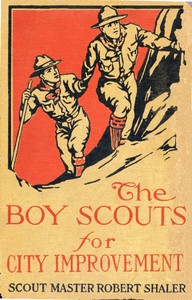
The source record for The Boy Scouts for City Improvement — A Closer Reading measures this digital text at 30,659 words, 2 hr 14 min estimated reading time, and 4 detected text sections.
The text analysis averages about 20.9 words per sentence, while the detected sections provide another way to judge how the source is divided.
Project Gutenberg metadata also associates the work with “Mystery and detective stories,” connecting these edition facts with the source record’s subject description.
Explore this collection
These alternatives are selected using recorded categories and estimated reading time.
About 133 minutes
Childrens Adventures
30,486 recorded words. 1 minutes difference from this book's estimate.
View Gutenberg source #49269About 129 minutes
Childrens Adventures
29,510 recorded words. 5 minutes difference from this book's estimate.
View Gutenberg source #48410About 126 minutes
Childrens Adventures
28,862 recorded words. 8 minutes difference from this book's estimate.
View Gutenberg source #44731Search stored excerpts and compare books → Choose by your preferences →
Choices use stored catalog measurements. Estimates vary with reading speed. A shared category is a catalog label, not a claim that two books have the same argument or literary quality.
Search reads excerpt text stored with this catalog and links to its associated Gutenberg record. The connection is stored in the site database; this tool does not recheck that every excerpt is word-for-word identical to that external record. Excerpt search does not cover every chapter and does not verify historical publication dates.
Catalog snapshot checked: 2026-09-26. Coverage: 90 public books, 90 available source excerpts.
Calculated from edition completeness, EPUB availability, text structure and catalogue metadata. Not a user rating.
Total of 100 points, scaled to a 2.5-5.0 range. Editions with an empty description or a missing EPUB file are not scored.
Public-domain source text
The source text is kept in the dedicated reader, separate from this catalogue record and its commentary.
Robert Shaler opens The Boy Scouts for City Improvement with a leisurely exchange between two scouts, Hugh Hardin and Billy Worth, seated under a historic oak. The dialogue is casual—Billy jokes about the heat and wishes for skating weather—but the scene quickly establishes the story’s dual focus: the boys’ camaraderie and their role as civic agents. Shaler’s diction is plain and functional, favoring concrete nouns like “stone curbing” and “khaki uniforms” over abstraction. The oak, named after General Putnam, anchors the setting in a specific local history, hinting at the patriotic undertones that will surface later. This opening paragraph balances exposition with character voice, letting readers infer the troop’s structure and the boys’ personalities through their banter rather than through authorial summary.
Shaler’s word choices consistently reinforce the scout identity. Terms like “patrol,” “beat,” and “first-class scout” are used without explanation, assuming reader familiarity with the Boy Scout movement. The narrator refers to Billy as “Billy the Wolf” and notes his “long-drawn howl,” blending organizational jargon with affectionate nickname. This diction creates an insider tone, as if the reader is already part of the troop. At the same time, Shaler avoids technical or flowery language; even moments of tension are described in simple verbs: “came a flying figure,” “walked off at a more rapid pace.” The result is a style that mirrors the scouts’ own practicality—efficient, direct, and focused on action.
Dialogue carries much of the characterization. Billy’s speech is marked by self-deprecating humor and a love of comfort: he admits to being “half dead for sleep” and jokes about watching others work. Hugh, by contrast, speaks in measured, analytical sentences, often speculating about motives or plans. Their exchange about the mayor’s proclamation and the “pull” of influential families reveals a class-conscious awareness unusual in children’s adventure fiction of the era. Shaler also uses dialogue to convey information efficiently—when Hugh identifies a shadowy figure as “Andy Wallis,” the Chief’s nephew, the reader learns both the character’s name and his potential conflict of interest without a separate description.
Shaler’s descriptions are economical, often serving dual purposes. The “General Putnam oak” not only provides shade but also evokes Revolutionary patriotism, aligning the scouts with a tradition of civic duty. Physical details about the boys—Billy’s “fat leg,” his “stubborn spirit,” his “genial good nature”—are woven into action rather than listed. When Arthur Cameron appears “wild with fresh excitement,” the description is minimal but effective, relying on the reader’s understanding of the patrol system to grasp the urgency. Shaler also uses setting to mirror mood: the “shadow of a willow tree” and the “shadowy figure” across the street create a visual contrast between safety and threat, reinforcing the story’s moral geography.
Several motifs recur in the excerpts. The heat of the September day is mentioned repeatedly, serving as both a physical obstacle and a source of comic relief (Billy’s drowsiness). The act of “watching” or “spying” is central: Hugh and Billy observe passersby, suspect Andy Wallis of reconnaissance, and exchange passwords with other scouts. This surveillance motif aligns with the book’s subtitle, City Improvement, suggesting that vigilance is a form of civic participation. Shaler also repeats the phrase “something may happen” or “something stirring,” building anticipation through incremental repetition. Structurally, the narrative moves from static conversation to sudden action—a pattern that likely recurs throughout the novel, as suggested by chapter titles like “The Fire Call” and “The Alarm.”
Readers approaching The Boy Scouts for City Improvement should attend to how Shaler balances instruction with entertainment. The book is not a manual but a story that embeds scout values in plot and dialogue. Notice how the author uses the patrol system as a narrative framework, with each scout’s role contributing to the group’s effectiveness. The excerpts suggest a world where civic duty is personal, and where even a boy’s nickname or a shared joke can signal allegiance. This is a work that rewards attention to the small details of character and setting, even as it propels readers toward the next chapter’s promise of action.
There’s something about Shaler’s patrol banter that still feels like a quiet afternoon’s company. I found myself thinking of that same unhurried loyalty while reading The Bungalow Boys in the Great Northwest — Text and Context—not for plot, but for that old-fashioned warmth of boys finding their way through trouble together. A familiar, wistful comfort.
Answer a few questions and save a private reflection on this device.