About 163 minutes
Motor Matt's Hard Luck; or, The Balloon-House Plot — Reading Companion
Childrens Adventures
37,276 recorded words. 1 minutes difference from this book's estimate.
View Gutenberg source #47975
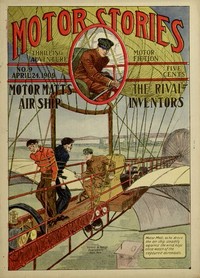
This digital edition of Motor Matt's Air Ship; or, The Rival Inventors — Reading Notes is described by source-level measurements including 37,125 words, 2 hr 42 min estimated reading time, and 4 detected text sections.
The text analysis averages about 14.0 words per sentence, while the detected sections provide another way to judge how the source is divided.
Project Gutenberg metadata also associates the work with “Adventure stories,” connecting these edition facts with the source record’s subject description.
Explore this collection
These alternatives are selected using recorded categories and estimated reading time.
About 163 minutes
Childrens Adventures
37,276 recorded words. 1 minutes difference from this book's estimate.
View Gutenberg source #47975About 161 minutes
Childrens Adventures
36,925 recorded words. 1 minutes difference from this book's estimate.
View Gutenberg source #48524About 161 minutes
Childrens Adventures
36,963 recorded words. 1 minutes difference from this book's estimate.
View Gutenberg source #48591Search stored excerpts and compare books → Choose by your preferences →
Choices use stored catalog measurements. Estimates vary with reading speed. A shared category is a catalog label, not a claim that two books have the same argument or literary quality.
Search reads excerpt text stored with this catalog and links to its associated Gutenberg record. The connection is stored in the site database; this tool does not recheck that every excerpt is word-for-word identical to that external record. Excerpt search does not cover every chapter and does not verify historical publication dates.
Catalog snapshot checked: 2026-09-26. Coverage: 90 public books, 90 available source excerpts.
Calculated from edition completeness, EPUB availability, text structure and catalogue metadata. Not a user rating.
Total of 100 points, scaled to a 2.5-5.0 range. Editions with an empty description or a missing EPUB file are not scored.
Public-domain source text
The source text is kept in the dedicated reader, separate from this catalogue record and its commentary.
From the opening line—"Py shiminy grickets! Vat do you t'ink oof dot!"—Stanley R. Matthews establishes Carl Pretzel's thick German dialect as a recurring comic and phonetic marker. This choice immediately signals the dime-novel tradition of ethnic humor while also grounding the reader in a specific auditory landscape. The dialect is not merely decorative; it contrasts sharply with Motor Matt's plain, efficient speech, reinforcing Matt's role as the capable, unaccented hero. Matthews uses this linguistic divide to underscore character roles without lengthy exposition.
Carl Pretzel's dialogue is the most distinctive feature of the prose. His pronunciation—"lopsder" for lobster, "palloon" for balloon—is consistent and phonetically spelled, creating a verbal tic that readers would immediately associate with comic relief. Yet Matthews does not let the dialect become a mere gag; Carl's observations often drive the plot forward, as when he spots the air-ship first. In contrast, Motor Matt speaks in crisp, unaccented English: "Let me get out there and see what is going on!" This dichotomy between the two boys' voices mirrors the dime-novel convention of pairing a resourceful hero with a bumbling sidekick, but Matthews gives Carl enough agency to avoid pure caricature.
Matthews distinguishes between honest and criminal inventors through their dialogue. Hamilton Jerrold, the rightful inventor, is described in the character list as having "devoted his life to aeronautics," and his air-ship is called the Eagle. Hector Brady, the rival, has "stolen his ideas" and uses the Hawk for robbery. The names themselves—Eagle versus Hawk—carry moral weight: the eagle suggests nobility, the hawk predation. When Helen Brady explains her father's crimes, she uses words like "blind" and "open and aboveboard," revealing a vocabulary of deception that contrasts with Matt's directness. Matthews thus embeds moral judgment in the very terminology of the air-ships.
The excerpts offer sparse but effective setting details. The story opens with Matt and Carl "sitting by a quiet country roadside, in the shade of some trees," with a "light touring-car" nearby. This mundane, grounded scene is abruptly disrupted by Carl's skyward exclamation. Later, the swamp setting is evoked through sound: "a babel of excited voices" and "reports" of rifle fire. The girl reports that the other air-ship "is moving very slowly and seems to be in trouble," using simple, visual language. Matthews relies on a few concrete nouns—"cot," "doorway," "gas-bag"—to build tension, never over-describing but letting action and dialogue carry the atmosphere.
Matthews uses dialogue not just for character but to advance the story efficiently. In Chapter XI, nearly all key information is delivered through conversation: the girl explains her father's criminal history, Matt deduces that Carl has arrived with help, and the girl outlines her plan. The exchange is rapid and functional, with lines like "I'll bet it's somebody who's come looking for me!" and "He'll be badly cut up over this." This technique keeps the pace brisk, typical of serial fiction. Matthews also uses dialogue to reveal backstory—Helen's confession that her father "stole all his ideas from Jerrold" comes naturally in conversation, avoiding narrative intrusion.
Readers attentive to Matthews' craft will notice how he balances the demands of serial adventure with consistent character voices. The dialect work, while broad, is applied with enough regularity to become a reliable marker of Carl's presence. The moral vocabulary attached to the rival inventors—honest versus stolen, open versus secret—gives the air-ship chase a thematic undercurrent. This edition invites scrutiny of how Matthews turns dime-novel conventions into a tight, dialogue-driven narrative.
Reading about Carl Pretzel’s tangled dialect makes me think of my grandfather, who used to read these old serials aloud, fumbling the accents with a grin. That warmth comes back in The River Motor Boat Boys on the Amazon; Or, The Secret of Cloud Island — Context and Discussion, where the river feels just as patient and knowing as the inventor’s workshop did. A quiet hum of danger, mostly left unsaid.
Answer a few questions and save a private reflection on this device.