About 161 minutes
Motor Matt's Queer Find; or, The Secret of the Iron Chest — Background and Themes
Childrens Adventures
36,925 recorded words. 0 minutes difference from this book's estimate.
View Gutenberg source #48524
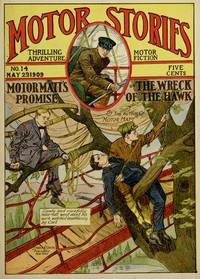
Before opening Motor Matt's Promise; or, The Wreck of the Hawk — Reading Companion, the edition data offers a quick orientation: 36,963 words, 2 hr 41 min estimated reading time, and 4 detected text sections.
The text analysis averages about 14.5 words per sentence, while the detected sections provide another way to judge how the source is divided.
Project Gutenberg metadata also associates the work with “Adventure stories,” connecting these edition facts with the source record’s subject description.
Explore this collection
These alternatives are selected using recorded categories and estimated reading time.
About 161 minutes
Childrens Adventures
36,925 recorded words. 0 minutes difference from this book's estimate.
View Gutenberg source #48524About 162 minutes
Childrens Adventures
37,125 recorded words. 1 minutes difference from this book's estimate.
View Gutenberg source #47901About 163 minutes
Childrens Adventures
37,276 recorded words. 2 minutes difference from this book's estimate.
View Gutenberg source #47975Search stored excerpts and compare books → Choose by your preferences →
Choices use stored catalog measurements. Estimates vary with reading speed. A shared category is a catalog label, not a claim that two books have the same argument or literary quality.
Search reads excerpt text stored with this catalog and links to its associated Gutenberg record. The connection is stored in the site database; this tool does not recheck that every excerpt is word-for-word identical to that external record. Excerpt search does not cover every chapter and does not verify historical publication dates.
Catalog snapshot checked: 2026-09-26. Coverage: 90 public books, 90 available source excerpts.
Calculated from edition completeness, EPUB availability, text structure and catalogue metadata. Not a user rating.
Total of 100 points, scaled to a 2.5-5.0 range. Editions with an empty description or a missing EPUB file are not scored.
Public-domain source text
The source text is kept in the dedicated reader, separate from this catalogue record and its commentary.
The story opens with Carl Pretzel and Dick Ferral reacting in comic disbelief—"Py shiminy grickets!" and "Well, strike me lucky!"—to a sight on the levee that sets up the central confusion: Motor Matt has a double. The narrative voice leans into vernacular exclamations and nautical slang, marking it as a boys' adventure serial from 1909. The table of contents promises a wreck, a bag of diamonds, and a Scotland Yard surprise, but the excerpts focus on a tense capture scene where Matt pins his double, Joe Dashington, and demands information about the rogue trio Jurgens, Whistler, and Bangs.
The title's "Promise" is invoked early but not explained in the excerpts. What is clear is the doppelgänger device: Joe Dashington, described as "Motor Matt's double," has impersonated the hero to steal diamonds from Archibald Townsend. The capture scene in Chapter XI shows Matt physically overpowering Dashington—"Being far and away Dashington's superior in science, Matt was only about two minutes in laying his antagonist on his back"—but the dialogue quickly shifts from confrontation to negotiation. Dashington claims he wrote a warning letter, using Bangs' notebook and pencil, and that he was himself robbed by the gang after lifting the "sparks." The promise may refer to Matt's word to protect someone or to recover the diamonds, but the text leaves that thread dangling.
The characters speak in thick period slang that distinguishes them. Dashington's patter is especially dense: "Pass it up, King," "heave a little of the straight guff," and "I'll bet eight big iron louies." Dick Ferral uses sailor terms like "swab" and "main queer," while Carl Pretzel's German-accented English provides comic relief ("Py shiminy grickets!" "der plind shtaggers"). This linguistic layering creates a vivid sense of milieu—the levee, the airship, the auto chase—even when the plot mechanics are unclear. The author, Stanley R. Matthews, relies on these voices to carry the action forward, especially in scenes where physical description is minimal.
The wreck of the Hawk is promised by the title and the chapter list, but the excerpts do not depict the crash itself. Instead, they show the aftermath: Matt and his friends are on the ground, dealing with Dashington and the missing diamonds. The airship is a central prop—the catalog subjects list "Airships -- Juvenile fiction"—but the surviving text focuses on interpersonal conflict and chase logistics. The wreck may be the event that strands the characters and forces Matt to fulfill his promise, but the excerpts only hint at this through Dashington's complaint that his "ticket is merely a souvenir" and that he got "rung into the biggest Jonah play." The reader must infer the crash's role from the title and chapter headings alone.
Readers should pay attention to how the promise motif recurs—it is named in the title and in Chapter V, but the excerpts do not reveal its content. The double identity plot, the slang-rich dialogue, and the shifting alliances (Dashington claims to be a "friend from the enemy's camp") are the story's engine. The wreck itself remains offstage, a blank that the reader must fill from the characters' reactions and the serial's conventions.
Reading about Motor Matt’s tangled promise, I remembered a summer afternoon when I felt the same weight of an oath given too quickly. The wreck of the Hawk, that wrestling match, all of it felt less about diamonds and more about who we become when tested. The Adventures of Billy Topsail — Reading Notes once gave me that exact quiet ache—a boy’s word bending under weather and want, and my own heart leaning in. Books like these don’t leave; they sit beside you.
Your answers remain private and are stored only in this browser.