About 163 minutes
Stormy Voyage Sandy Steele Adventures #3 — Themes and Context
Childrens Adventures
37,349 recorded words. 0 minutes difference from this book's estimate.
View Gutenberg source #50238
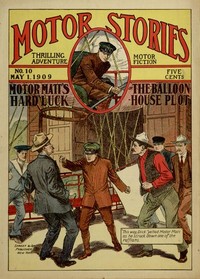
The source record for Motor Matt's Hard Luck; or, The Balloon-House Plot — Reading Companion measures this digital text at 37,276 words, 2 hr 43 min estimated reading time, and 4 detected text sections.
The text analysis averages about 14.6 words per sentence, while the detected sections provide another way to judge how the source is divided.
Project Gutenberg metadata also associates the work with “Adventure stories,” connecting these edition facts with the source record’s subject description.
Explore this collection
These alternatives are selected using recorded categories and estimated reading time.
About 163 minutes
Childrens Adventures
37,349 recorded words. 0 minutes difference from this book's estimate.
View Gutenberg source #50238About 162 minutes
Childrens Adventures
37,125 recorded words. 1 minutes difference from this book's estimate.
View Gutenberg source #47901About 161 minutes
Childrens Adventures
36,925 recorded words. 2 minutes difference from this book's estimate.
View Gutenberg source #48524Search stored excerpts and compare books → Choose by your preferences →
Choices use stored catalog measurements. Estimates vary with reading speed. A shared category is a catalog label, not a claim that two books have the same argument or literary quality.
Search reads excerpt text stored with this catalog and links to its associated Gutenberg record. The connection is stored in the site database; this tool does not recheck that every excerpt is word-for-word identical to that external record. Excerpt search does not cover every chapter and does not verify historical publication dates.
Catalog snapshot checked: 2026-09-26. Coverage: 90 public books, 90 available source excerpts.
Calculated from edition completeness, EPUB availability, text structure and catalogue metadata. Not a user rating.
Total of 100 points, scaled to a 2.5-5.0 range. Editions with an empty description or a missing EPUB file are not scored.
Public-domain source text
The source text is kept in the dedicated reader, separate from this catalogue record and its commentary.
From its first page, Motor Matt's Hard Luck; or, The Balloon-House Plot announces itself as a product of the early twentieth-century dime-novel tradition, where speed—both mechanical and narrative—is paramount. The story opens with Carl Pretzel's distinctive dialect: "Py chimineddy!" a verbal signature that immediately signals the comic-relief sidekick. The catalog lists the book as a children's adventure, but the excerpts reveal a surprisingly dense web of rival inventors, stolen airships, and a girl caught between her criminal father and her own conscience.
The tension between honest and dishonest innovation runs through the text. Hamilton Jerrold, the upright inventor of the airship Eagle, stands in opposition to Hector Brady, who uses his Hawk for theft. Matt King, the hero, must navigate this moral landscape while recovering a stolen machine and protecting Helen Brady, whose family ties make her an ambiguous figure. The excerpts show a world where mechanical expertise is a form of virtue, and where every character's loyalty is tested by the promise of flight.
The excerpts showcase a deliberate use of dialect to differentiate characters and signal their roles. Carl Pretzel's speech is the most exaggerated: "Dot feller vouldt do anyt'ing for Matt," he says, with dropped consonants and vowel shifts that mark him as the comic German immigrant. This is not mere decoration; it creates a verbal texture that distinguishes him from Matt's more standard English and from Dick Ferral's nautical slang, as when Ferral says, "You've got me in a monkey's fist again."
Helen Brady, by contrast, speaks without dialect, which may reflect her position as a moral fulcrum—neither fully part of the criminal world nor entirely innocent. The author uses these voices to compress character information: Carl's loyalty is expressed through his broken syntax, while Ferral's naval background appears in his idioms. Readers of the original dime novel would have recognized these shorthand cues instantly, allowing the story to move quickly without lengthy exposition.
The plot hinges on the theft of the Hawk, an airship that Matt and Dick have just purchased. The excerpts show Matt's immediate concern with legal ownership: "Who loses der air ship?" Carl asks, and Ferral replies, "Der bolice, oder Matt und Tick?" The answer is clear: the buyers bear the loss. This emphasis on property and responsibility reflects the dime novel's moral economy, where honest work and fair purchase are virtues, and theft is a crime against both law and personal honor.
Matt's response to the theft is not revenge but practical action: he plans to report to the police and seek help from Jerrold. The text repeatedly links mechanical skill with moral reliability. Jerrold is trustworthy because he is a genuine inventor; Brady is corrupt because he steals ideas. The airships themselves become symbols: the Eagle represents legitimate innovation, the Hawk criminal appropriation. This binary structure gives the adventure a clear ethical framework without slowing the pace.
Helen Brady occupies an unusual position in the story: she is the daughter of the villain, yet she helps Motor Matt. The excerpts show her as a figure of pathos: "A sad look crossed the girl's face. With her father and her brother both criminals, her position was forlorn, indeed." Matt gives her money, but she refuses contributions from Ferral and Carl, accepting only Matt's two ten-dollar bills. This moment of charity is also a moment of judgment—Helen is separated from her family's crimes but not fully integrated into the heroes' circle.
The text does not resolve her fate in the provided excerpts. She plans to stay with friends in Chicago and find work, but her future remains uncertain. This ambiguity is notable in a genre that usually ties up all loose ends. Helen's presence complicates the simple good-versus-evil structure, suggesting that even in a fast-paced adventure, some characters exist in a moral gray area, neither fully redeemed nor condemned.
Readers approaching Motor Matt's Hard Luck should pay attention to the way the story uses mechanical details—airships, gas, theft of blueprints—as both plot devices and moral indicators. The dialect may slow modern readers, but it rewards attention with character depth. The book is best read as a period artifact where speed, loyalty, and invention are intertwined, and where even a villain's daughter can earn a moment of sympathy. The incomplete excerpts leave several threads dangling, but the central tension between honest and dishonest flight is clear throughout.
Reading of Motor Matt recovering the Hawk, I remembered my grandfather’s hands fixing a broken fan, patient and sure. There was a quiet dignity in that work, much like the boy in A Dog of Flanders, The Nürnberg Stove, and Other Stories — Key Ideas to Explore finding his own kind of worth in simple, earnest devotion. Both felt like tests of the heart, not just skill.
Save your reaction, strongest insight, and memorable passage.