About 231 minutes
The Motor Boys Over the Ocean; Or, A Marvelous Rescue in Mid-Air — Context and Discussion
Childrens Adventures
53,097 recorded words. 2 minutes difference from this book's estimate.
View Gutenberg source #46127
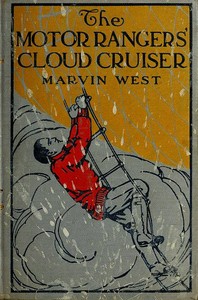
The catalog record for The Motor Rangers' Cloud Cruiser — Key Ideas to Explore provides practical reading context through 52,474 words, 3 hr 49 min estimated reading time, and 8 detected text sections.
The text analysis averages about 15.1 words per sentence, while the detected sections provide another way to judge how the source is divided.
Project Gutenberg metadata also associates the work with “Islands -- Juvenile fiction,” connecting these edition facts with the source record’s subject description.
Explore this collection
These alternatives are selected using recorded categories and estimated reading time.
About 231 minutes
Childrens Adventures
53,097 recorded words. 2 minutes difference from this book's estimate.
View Gutenberg source #46127About 233 minutes
Childrens Adventures
53,538 recorded words. 4 minutes difference from this book's estimate.
View Gutenberg source #50253About 235 minutes
Childrens Adventures
53,902 recorded words. 6 minutes difference from this book's estimate.
View Gutenberg source #50816Search stored excerpts and compare books → Choose by your preferences →
Choices use stored catalog measurements. Estimates vary with reading speed. A shared category is a catalog label, not a claim that two books have the same argument or literary quality.
Search reads excerpt text stored with this catalog and links to its associated Gutenberg record. The connection is stored in the site database; this tool does not recheck that every excerpt is word-for-word identical to that external record. Excerpt search does not cover every chapter and does not verify historical publication dates.
Catalog snapshot checked: 2026-09-26. Coverage: 90 public books, 90 available source excerpts.
Calculated from edition completeness, EPUB availability, text structure and catalogue metadata. Not a user rating.
Total of 100 points, scaled to a 2.5-5.0 range. Editions with an empty description or a missing EPUB file are not scored.
Public-domain source text
The source text is kept in the dedicated reader, separate from this catalogue record and its commentary.
The Motor Rangers' Cloud Cruiser opens with a familiar scene from the series: the young adventurers aboard their motorboat, the Nomad, facing a storm. But the narrative quickly pivots from pitching waves to the promise of flight. The transition from sea to air is not gradual; it is a structural leap, mirrored by the sudden appearance of the airship Discoverer. This movement between elements—water, air, and later, a mysterious island—defines the book's rhythm.
The early chapters establish the Nomad as a familiar, stable base. The storm scene (Chapter I) emphasizes the boat's pitching and tumbling, described as 'like a bucking broncho.' This maritime setting is abruptly left behind when the boys acquire the airship. The shift is not just technological; it reorients the story's spatial logic. The Nomad's deck gives way to the Discoverer's substructure, and the horizon line, once defined by waves, becomes a vertical plane. The narrative now moves through altitude as much as distance.
One of the most distinctive objects in the excerpts is the 'Fog-maker,' a gun that fires glass projectiles filled with chemicals, producing a thick, acrid smoke. The professor explains it was inspired by Chinese pirates' 'stink-pots.' The weapon does not kill but incapacitates, rendering breathers insensible. This device reflects the story's interest in non-lethal, disorienting technology. The smoke cloud also visually echoes the atmospheric disturbances—storms, fog, and the 'magnetic island'—that pervade the narrative, blurring boundaries between natural and artificial phenomena.
A key structural pattern is the sudden vertical event. In Chapter XIX, the crew discovers a man clinging to the rope dangling from the ascending Discoverer. The rope, meant for mooring, becomes a lifeline for an unexpected passenger. This moment repeats the earlier shock of the 'magnetic island' vanishing, and later, the rescue of a man from a height. The narrative repeatedly uses vertical movement—ascents, descents, and dangling figures—to generate suspense. The airship's altitude (fifteen hundred feet) is specified, grounding the fantasy in measurable space.
Ropes appear as crucial props: the mooring rope that snags a passenger, the rope used to haul up the 'Fog-maker' projectiles, and the rope coiled after a hasty ascent. Arrows, too, recur—first as threats from an unseen enemy, then as objects to be gathered and thrown away. These items are not merely functional; they create a tactile, physical world. The arrows are 'deadly missiles' that must be searched for and discarded. The narrative lingers on the handling of objects, from the glass projectiles to the coiled rope, grounding the airship adventure in concrete, hands-on detail.
Readers attentive to structure will notice how Goldfrap uses the airship not as a static setting but as a device for reorienting the story's geometry. The shift from sea to sky, the repeated vertical surprises, and the focus on tangible objects like ropes and arrows give the narrative a distinctive, physical texture. The excerpts suggest a work that values movement and materiality over character depth, making the Cloud Cruiser itself the true protagonist.
There’s something tender about how these old stories keep returning to the moment of lift-off, that sudden escape from water into air. It reminds me of the quiet longing threaded through The River Motor Boat Boys on the Yukon: The Lost Mine of Rainbow Bend — Context and Discussion, where the river itself feels like a held breath before the next bend. Both leave me staring out a window. The Cloud Cruiser’s fog-maker always felt less like a weapon, more like a way to disappear for a while.
Answer a few questions and save a private reflection on this device.