About 259 minutes
The River Motor Boat Boys on the Yukon: The Lost Mine of Rainbow Bend — Context and Discussion
Childrens Adventures
59,552 recorded words. 1 minutes difference from this book's estimate.
View Gutenberg source #50831
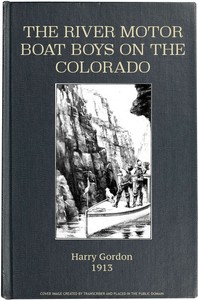
The source record for The River Motor Boat Boys on the Colorado; Or, The Clue in the Rocks — Inside the Classic measures this digital text at 59,785 words, 4 hr 20 min estimated reading time, and 23 detected text sections.
The text analysis averages about 13.7 words per sentence, while the detected sections provide another way to judge how the source is divided.
Project Gutenberg metadata also associates the work with “Boats and boating -- Juvenile fiction,” connecting these edition facts with the source record’s subject description.
Explore this collection
These alternatives are selected using recorded categories and estimated reading time.
About 259 minutes
Childrens Adventures
59,552 recorded words. 1 minutes difference from this book's estimate.
View Gutenberg source #50831About 258 minutes
Childrens Adventures
59,293 recorded words. 2 minutes difference from this book's estimate.
View Gutenberg source #50123About 264 minutes
Childrens Adventures
60,552 recorded words. 4 minutes difference from this book's estimate.
View Gutenberg source #44954Search stored excerpts and compare books → Choose by your preferences →
Choices use stored catalog measurements. Estimates vary with reading speed. A shared category is a catalog label, not a claim that two books have the same argument or literary quality.
Search reads excerpt text stored with this catalog and links to its associated Gutenberg record. The connection is stored in the site database; this tool does not recheck that every excerpt is word-for-word identical to that external record. Excerpt search does not cover every chapter and does not verify historical publication dates.
Catalog snapshot checked: 2026-09-26. Coverage: 90 public books, 90 available source excerpts.
Calculated from edition completeness, EPUB availability, text structure and catalogue metadata. Not a user rating.
Total of 100 points, scaled to a 2.5-5.0 range. Editions with an empty description or a missing EPUB file are not scored.
Public-domain source text
The source text is kept in the dedicated reader, separate from this catalogue record and its commentary.
The first chapter situates the motor boat Rambler with unusual geographic precision: the Gulf of California, the Colorado's “shifting currents and treacherous sandbars,” and the Sierra del Pinacates mountains are all named within the opening paragraphs. The sun rises “round and red and hot, like the bottom of a great brass kettle”—a simile that grounds the desert setting in sensory heat. The crew of three, Clayton, Cornelius, and Alexander, are introduced as veterans of earlier voyages on the Amazon and Columbia, but the narrative quickly shifts from travelogue to a tense, enclosed predicament.
The opening chapter does not merely list locations; it builds a stage. The Rambler lies at anchor in the Gulf of California, with the Colorado River opening to the north and a Mexican desert to the east. The description of the desert as “a waste of sand, which had, in times long gone by, formed the bed of a lake” adds a geological depth that hints at hidden histories. The Montague islands and the Pacific Ocean are also referenced, creating a sense of isolation—the boys are at the edge of known waterways. This precise setting is not decorative; it becomes the arena for the later crisis, where the river’s rising water and crumbling banks directly threaten the old house. The geography is a character in itself, shaping the boys’ options and dangers.
The middle excerpts center on a life-or-death puzzle: the boys are locked in an iron-sheathed room in a collapsing house, with water rising from the cellar. The solution hinges on a forgotten childhood memory—a spring that opens the door from the inside. Tom, one of the trapped boys, recalls that his uncle David once showed him and Don “all about this treasure room,” but he cannot remember the mechanism. Clay, the more pragmatic leader, urges him: “Was it down low or up high? … You ought to be able to remember.” The dialogue reveals a contrast between Tom’s fear (“I’m terrified in the dark and in places where strength doesn’t count”) and Clay’s insistence that “courage always counts.” The scene is a classic adventure-trap, but the clue is not a physical object—it is a recovered memory, making the boys’ own past the key to survival.
As the water rises, the narrative layers external and internal sounds. The trapped boys hear “voices outside, though they came dully to their ears,” and “now and then a crash came which told of falling timbers.” The house is literally disintegrating around them. Meanwhile, outside, Don, Alex, and Captain Joe are trying to reach the room, but an “officious crowd” seizes and draws them back. The tension is doubled: the boys inside must find the spring before the water drowns them, while their friends are physically prevented from helping. The excerpt from Chapter XII ends with Clay realizing “the foundations of the house were falling in more places than one,” but the text cuts off before the resolution. This incomplete moment leaves the reader suspended in the crisis, with only the clue of the spring and the promise of Don’s eventual memory.
The book’s subtitle, “The Clue in the Rocks,” points to a mystery that is only hinted at in the excerpts. The table of contents lists a chapter with that exact title (Chapter XXI), suggesting that the iron room and the spring are not the final puzzle. The earlier chapters, such as “The Phantom Boarder” and “Concerning a Headless Ghost,” indicate a pattern of supernatural-seeming events that likely have rational explanations. The excerpts show that the boys rely on memory, observation, and persistence—Clay uses his electric light to “weave it over every inch of the iron sheathing”—rather than luck. Readers can expect that the titular clue will be a physical or geological detail, consistent with the book’s attention to landscape and hidden mechanisms.
The excerpts present a story that moves from broad geographic description to a tight, claustrophobic crisis. The boys’ past adventures on other rivers are referenced but not detailed, so new readers can start here without prior knowledge. Pay attention to how the setting—the river, the desert, the old house—functions as both obstacle and source of clues. The incomplete rescue scene is a deliberate hook; the resolution likely depends on Don’s recovered memory and the “clue in the rocks” promised by the title.
That locked-room moment on the Colorado, where a boy’s memory of a hidden spring turns the tide, stayed with me—how the smallest detail can save a life. The same quiet weight lingers in The Boy Scouts in the Saddle — Inside the Classic, though there the landscape is open desert, not crumbling walls. Both feel like old friends, patient with their clues.
Build a private reading journal entry for this title.