About 367 minutes
The Island of Yellow Sands: An Adventure and Mystery Story for Boys — Text and Context
Childrens Adventures
84,337 recorded words. 139 minutes difference from this book's estimate.
View Gutenberg source #46271
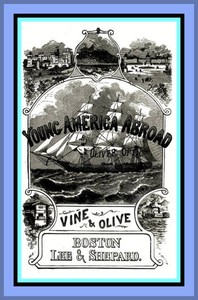
This digital edition of Vine and Olive; Or, Young America in Spain and Portugal A Story of Travel and Adventure — Reading Companion is described by source-level measurements including 116,239 words, 8 hr 26 min estimated reading time, and 13 detected text sections.
The text analysis averages about 17.8 words per sentence, while the detected sections provide another way to judge how the source is divided.
Project Gutenberg metadata also associates the work with “Voyages and travels -- Juvenile fiction,” connecting these edition facts with the source record’s subject description.
Explore this collection
These alternatives are selected using recorded categories and estimated reading time.
About 367 minutes
Childrens Adventures
84,337 recorded words. 139 minutes difference from this book's estimate.
View Gutenberg source #46271About 352 minutes
Childrens Adventures
80,776 recorded words. 154 minutes difference from this book's estimate.
View Gutenberg source #45537About 301 minutes
Childrens Adventures
69,034 recorded words. 205 minutes difference from this book's estimate.
View Gutenberg source #45667Search stored excerpts and compare books → Choose by your preferences →
Choices use stored catalog measurements. Estimates vary with reading speed. A shared category is a catalog label, not a claim that two books have the same argument or literary quality.
Search reads excerpt text stored with this catalog and links to its associated Gutenberg record. The connection is stored in the site database; this tool does not recheck that every excerpt is word-for-word identical to that external record. Excerpt search does not cover every chapter and does not verify historical publication dates.
Catalog snapshot checked: 2026-09-26. Coverage: 90 public books, 90 available source excerpts.
Calculated from edition completeness, EPUB availability, text structure and catalogue metadata. Not a user rating.
Total of 100 points, scaled to a 2.5-5.0 range. Editions with an empty description or a missing EPUB file are not scored.
Public-domain source text
The source text is kept in the dedicated reader, separate from this catalogue record and its commentary.
Oliver Optic’s Vine and Olive moves its young American protagonists through Spain and Portugal in a pattern that alternates shipboard lectures with onshore excursions. The narrative rhythm is set by the Academy Squadron’s ports of call, each providing a fresh backdrop for the surgeon Dr. Winstock’s encyclopedic commentary. The excerpts reveal a deliberate structural device: the professor of geography and history delivers formal lessons, while the surgeon offers informal, anecdotal knowledge during walks. This dual-layered instruction creates a texture where official information and offhand remarks compete for the reader’s attention.
The story’s architecture depends on a constant shuttling between the deck of the squadron’s vessel and the streets of Iberian cities. In the Toledo excerpt, the party passes through the Puerta del Sol, a Moorish gateway, then climbs a winding slope to a square. The description of Toledo as “dull, deserted, desolate, and inhospitable” contrasts sharply with the shipboard order. This oscillation between the familiar discipline of the ship and the alien, often decaying, landscape of Spain becomes a recurring structural pattern. The narrative does not linger; it moves briskly from one site to the next, mirroring the itinerary of a guided tour.
Dr. Winstock functions as the primary conduit for historical and cultural information. His speeches, often triggered by a monument or a street name, are woven into the action rather than set apart. In the cathedral, he explains the Gate of the Lost Child, linking a fresco to a medieval persecution of Jews. His tone is matter-of-fact, occasionally wry, as when he recounts the legend of St. James’s corpse making a seven-day voyage. The surgeon’s voice provides a consistent thread across disparate locations, giving the episodic travelogue a unifying intellectual center. Without his running commentary, the book would risk becoming a mere list of sights.
Two images recur with notable frequency: water in various forms—the sea, rivers, aqueducts, and even a donkey carrying water kegs—and stone, particularly in architectural ruins and monuments. The Toledo passage describes a donkey with a saddle holding kegs, a humble water-delivery system that contrasts with the grand marble of the cathedral. The surgeon’s remark about “a fricassee of marble” underscores the tension between functional and ornamental stone. These images reinforce the theme of a land where ancient structures and daily survival coexist, often uneasily. The narrative eye is drawn to what is built and what is eroded, both literally and culturally.
Optic explicitly states in the preface that his aim is to “instruct as well as amuse.” The transitions between scenes are often engineered to deliver a lesson. When the party moves from the Puerta del Sol to the cathedral square, the professor alludes to a previous discussion, linking geography to the present view. The surgeon’s tale of St. James’s corpse is introduced as a corrective to the students’ knowledge, blending hagiography with skepticism. These transitions are not merely spatial; they are pedagogical. The reader, like the young officers, is expected to absorb facts about Spanish history, architecture, and legend as the party walks. The structure thus mirrors a classroom in motion.
Readers approaching Vine and Olive should attend to the interplay between the surgeon’s informal lectures and the professor’s formal ones, as this dual voice shapes the book’s rhythm. The recurring motifs of water and stone offer a way to track the author’s thematic concerns beyond the surface adventure. Because the excerpts cover only a portion of the journey, the full arc of the squadron’s progress from Barcelona to Lisbon remains to be discovered, but the structural patterns evident here suggest a carefully orchestrated travelogue.
That afternoon, the rain blurred the windows while Vine and Olive drifted between Lisbon’s stone quays and the Academy’s white sails. I kept thinking about how water there felt like a boundary—of empires, of boys’ courage. The same unease surfaced later, unexpectedly, in The Boy Scouts of the Signal Corps — Context and Discussion, though its currents ran through wires and dark woods. One story’s coastline simply led to another’s silence.
Your answers remain private and are stored only in this browser.